

Mia Takahashi
A pop culture journalist, internet historian, and veteran of the 2010s Tumblr trenches. Specializing in how early anime fandoms shaped the modern internet, I write about the media that defined a generation of geeks.
Published: April 2, 2026 | 12 min read | Last updated: April 2, 2026
20 Years of Hetalia: Why the World Still Can't Get Enough of Nation-Kuns
In 2006, a Japanese art student at Parsons School of Design in New York City started doodling personified countries on his personal website. Twenty years later, Hetalia has produced seven anime seasons, a theatrical film, multiple stage musicals, two video games, and one of the most creatively prolific fanbases the internet has ever seen. The Hetalia 20th anniversary lands in a fandom landscape that this scrappy little webcomic helped build. From the LiveJournal kink memes that rewrote the rules of fan engagement to the Tumblr wars that became their own piece of internet folklore, Hetalia didn't just participate in online fan culture. It helped invent it. This is the story of how a series literally named "Useless Italy" became anything but.
⚡ Quick Answer
Hetalia: Axis Powers is a Japanese webcomic turned anime franchise created by Hidekaz Himaruya in 2006 that personifies countries as characters. Celebrating its 20th anniversary in 2026, the series shaped modern internet fandom culture and maintains roughly 60,500 works on AO3 alone.
You might also like
From a Dorm Room Doodle to a Global Phenomenon
Hidekaz Himaruya was born on May 8, 1985, in Koriyama, Fukushima. By 2006, he was a young art student who had moved to New York to attend Parsons, carrying with him a personal website called Kitayume (which had been running since 2003) and a head full of ideas about turning world history into comedy. His original concept was reportedly a story about a foolish hero living in New York City, but after stumbling across discussions in a World War II thread on 2channel, the idea morphed into something far stranger and more ambitious: what if countries were people?
The first strips appeared on Kitayume in the summer and fall of 2006, initially titled "Axis Powers Hetalia." The name itself is a portmanteau of hetare (a Japanese slang term roughly meaning "useless" or "pathetic" in an endearing way) and "Italia" (Italy). The joke was right there in the title: the series starred a lovably incompetent personification of Italy stumbling through World War II alongside a stern Germany and a reserved Japan.
What started as scattered comic strips on a personal blog snowballed faster than anyone expected. By 2008, Gentosha Comics had picked up the series for print publication, and the first two tankobon volumes sold over a million copies by late 2009. Himaruya, still in his early twenties, eventually dropped out of Parsons to pursue the publishing deal full time.
📊 Key Stat: The first two Hetalia manga volumes sold over 1 million copies by late 2009, making Himaruya one of the most successful webcomic-to-print transitions in manga history. (Wikipedia)
What Even Is Hetalia? The Concept Explained
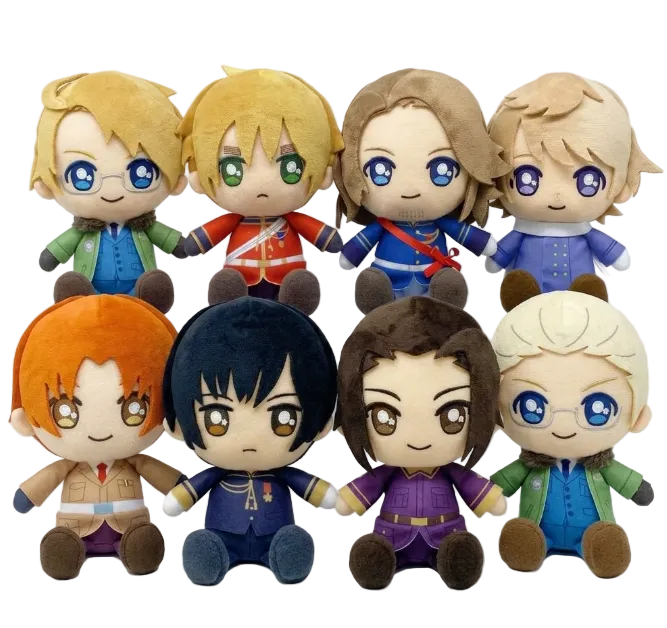
For the uninitiated (welcome, you're about to fall down a very specific rabbit hole), Hetalia personifies the nations of the world as immortal, anthropomorphic characters. Italy is a cheerful, pasta obsessed young man who surrenders at the first sign of conflict. America is a boisterous, hamburger loving self proclaimed hero. England is a prickly gentleman who practices black magic and has complicated feelings about his former colonies. Russia smiles constantly, and that smile scares everyone.
The genius of the premise is its infinite scalability. World War II provides the backbone for the early strips, but the format naturally expands to cover the Italian Renaissance, the American Revolution, the Napoleonic Wars, Viking Age Scandinavia, and modern day cultural misunderstandings at world summits. Each character carries both the stereotypes and the historical baggage of their nation, which makes for comedy that is simultaneously surface level goofy and surprisingly layered with historical references.
The cast eventually grew to represent over 60 countries and territories, from major players like France (a flirtatious romantic with a centuries old rivalry with England) to delightful deep cuts like Sealand (a micronation desperately seeking recognition) and Wy (whose real life prince actually praised Himaruya's work publicly).

Seven Seasons and a Movie: The Anime Empire
An anime adaptation was announced on July 24, 2008, with Studio Deen at the helm and Bob Shirohata directing. The format was unconventional: each episode ran roughly five minutes (including credits), making it one of the earliest successful "short form" anime series. The bite sized format turned out to be perfect for the internet era. Episodes were easy to share, binge, and gif into oblivion.
The anime's journey from 2009 to 2021 produced an impressive body of work. Here's the full timeline:
| Season | Title | Episodes | Year |
|---|---|---|---|
| 1 & 2 | Hetalia: Axis Powers | 52 | 2009 to 2010 |
| 3 & 4 | Hetalia: World Series | 48 | 2010 to 2011 |
| 5 | Hetalia: The Beautiful World | 20 | 2013 |
| 6 | Hetalia: The World Twinkle | 12 | 2015 |
| 7 | Hetalia: World Stars | 12 | 2021 |
| Film | Hetalia: Paint it, White! | 1 (feature) | 2010 |
The series totals 135 episodes, 13 OVAs, and a film. Funimation acquired the North American license in 2010 and became famous (or infamous, depending on whom you ask) for an English dub that gave each character a regional accent and added jokes that weren't in the original Japanese script. The dub became a polarizing but undeniably memorable element of Western Hetalia culture.
How Did Hetalia Shape Modern Internet Fandom?
I'll be honest: I was there. I was in the trenches. I remember the exact Tumblr post that pulled me in. It was 2011, I was supposed to be studying for a history exam, and instead I was reading a fan's 3,000 word character analysis of why England's relationship with America was an allegory for the emotional cost of colonialism. I aced the exam anyway because Hetalia had taught me more about the Seven Years' War than my textbook ever did. That's the paradox of this silly little show about nation kuns: it was simultaneously the most unserious thing on the internet and one of the most intellectually engaged fandoms of its era.
The Hetalia fandom didn't just exist on the early social web. It helped define it. The series arrived at the perfect inflection point: LiveJournal was still a thriving platform, DeviantArt was the hub for fan artists, Fanfiction.net was building its massive archive, and Tumblr was about to explode. Hetalia spread across all of them simultaneously, creating a kind of cross platform fandom infrastructure that became the template for everything that followed.
The Kink Meme Revolution
The Hetalia Kink Meme on LiveJournal became one of the largest and most active prompt based fan communities on the internet. While kink memes existed before Hetalia, the sheer volume and creativity of the Hetalia community helped popularize the format for subsequent fandoms. The concept of anonymous prompt fills, where fans request specific scenarios and other fans write them, became a foundational practice that would later migrate to platforms like Archive of Our Own (AO3).
Shipping as World Building
Hetalia's premise created a shipping culture unlike anything before it. When your characters literally are geopolitical relationships, every canon interaction has centuries of historical subtext baked in. The "USUK" ship (America x England) wasn't just two cute anime boys; it was the American Revolution, the War of 1812, the Special Relationship, and Lend Lease all filtered through fan creativity. This approach, treating canon as a launching pad for deeply researched, historically grounded fan interpretation, raised the bar for what shipping could be.
📊 Key Stat: As of February 2026, Hetalia has approximately 60,500 works on Archive of Our Own and over 120,000 on Fanfiction.net, making it one of the most written about anime franchises in fan fiction history. (Fanlore)
Convention Culture
Between 2009 and 2013, Hetalia cosplay was inescapable at anime conventions. Walk into any mid sized con and you'd find at least one group of friends doing a "world meeting" photoshoot, each dressed as a different country. The series normalized group cosplay and encouraged fans to learn about flag designs, military uniforms, and historical fashion in ways that spilled over into broader cosplay culture. It also taught an entire generation of con goers about cultural sensitivity the hard way, but more on that in a moment.

The Controversies: From South Korea to Anime Boston
You can't write an honest retrospective about Hetalia without talking about the elephants in the room. And there are several.
The South Korea Controversy
The most significant controversy erupted in January 2009 when the anime was about to air on Japan's Kids Station network. The character representing South Korea had already drawn criticism for what many perceived as mocking stereotypes, inaccurate cultural depictions (including an incorrectly drawn hanbok), and interactions with the Japan character that seemed to reference real territorial disputes like the Liancourt Rocks.
A petition on the Daum web portal collected over 12,000 signatures in a single day. The South Korean National Assembly addressed the issue, with Congresswoman Jeong Mi kyeong calling the series a "crime against Koreans." Kids Station pulled the anime from its TV lineup, though it still launched via mobile and online streaming. The Korea character was subsequently removed from the anime entirely and did not appear in any officially published Hetalia material for thirteen years until a 2021 fanbook.
"The diminishment of Korea's concerns and the infantilization of his character are consistent with more general depictions of colonized nations throughout the web comic and anime."
The Fandom's Own Reckoning
The series attracted valid criticism for its treatment of Axis powers history, particularly its choice to largely sidestep fascism, the Holocaust, and Japanese wartime atrocities. The English dub by Funimation added jokes that weren't in the original Japanese, some of which crossed lines the source material hadn't. A widely discussed incident at Anime Boston 2010 involving cosplayers performing Nazi salutes near what was reported to be a Holocaust memorial became one of the most cited examples of fandom behavior gone wrong and sparked serious conversations about the responsibilities that come with cosplaying historical military characters.
You might also like
These growing pains were real. But many veteran fans argue that the fandom's willingness to confront these issues, eventually, is part of what made it mature. Later seasons toned down problematic depictions, and the community itself developed norms around cultural sensitivity that would influence how subsequent anime fandoms handled similar questions.
⚠️ Important: While Hetalia uses humor to explore history, it is not a substitute for actual historical education. The series simplifies and omits significant atrocities, particularly those committed by the Axis powers. Enjoy the characters, but read the real history too.
@addyharajuku Lets talk about Hetalia and its problematic fandom #hetalia #fandomhistory #animeconvention
Is Hetalia Still Popular in 2026?
The short answer: yes, but differently than before.
The Hetalia fandom in 2026 is not the all consuming, convention dominating force it was circa 2012. But calling it "dead" is wildly inaccurate. The numbers paint a picture of a fandom that has matured, contracted, and concentrated its energy. AO3 hosts roughly 60,500 works as of early 2026. A dedicated Discord community, "The Vital Region 2.0," maintains close to 4,000 active members. Instagram tags related to Hetalia collectively represent over a million posts. The Tumblr tag #hetalia still has over 72,000 members, and fan events, zines, and themed weeks continue to be organized regularly.
On the official side, the Hetalia: World Stars manga continues to publish new chapters on Shonen Jump+. While no new anime season has been announced, the franchise has kept a presence through stage musicals and merchandise releases. The 2021 World Stars anime, which aired from April to June of that year, proved there was still an audience for new animated content.
What's perhaps most remarkable is how Hetalia keeps recruiting new fans. TikTok has become a gateway, with videos about the series regularly accumulating hundreds of thousands of views. Nostalgia posts from veterans mix with wide eyed reactions from newcomers discovering the series for the first time. The concept is evergreen: as long as countries interact on the world stage, the Hetalia cast has new material.
💡 Pro Tip: New to Hetalia in 2026? Start with the World Stars manga on Shonen Jump+ for the most current content, then work backwards through the anime seasons. The Beautiful World (Season 5) and World Twinkle (Season 6) feature improved animation and toned down characterizations compared to the earlier seasons.
The Legacy: What Hetalia Taught Us About Fandom
Looking back from 2026, twenty years after those first strips appeared on Kitayume, Hetalia's legacy is less about the anime itself and more about what it did to fan culture. Consider what it pioneered or popularized:
- Cross platform fandom: Hetalia was one of the first fandoms to simultaneously thrive on LiveJournal, DeviantArt, Fanfiction.net, YouTube, and Tumblr. This multi platform approach became the blueprint for how modern fandoms operate.
- History as fan fuel: The series demonstrated that real world history and geopolitics could be source material for fandom creativity. This DNA shows up everywhere from Countryhumans (Hetalia's spiritual successor) to the way fans analyze political dynamics between fictional factions in series like Attack on Titan.
- The fandom accountability era: The controversies forced the Hetalia community to grapple with questions about cultural sensitivity, historical responsibility, and appropriate convention behavior years before these conversations became standard across anime fandom.
- Webcomic to media empire pipeline: Himaruya's trajectory from personal blog to published manga to animated series to stage musicals previewed a path that countless web creators would follow in the years ahead.
There's also something beautifully appropriate about a series that personifies nations celebrating its twentieth anniversary. In a way, Hetalia's own story mirrors the characters it created: imperfect, occasionally messy, frequently misunderstood, but stubbornly enduring. The nation kuns keep showing up. So do their fans.
If you were part of the Hetalia fandom at any point in the last two decades, this anniversary belongs to you too. You were part of something that mattered, even when it was weird. Especially when it was weird.
Draw a circle. That's the earth. And twenty years later, we're all still here.
Frequently Asked Questions
Is Hetalia still popular in 2026?
Yes, though the fandom has matured from its 2010 to 2013 peak. Hetalia maintains roughly 60,500 fan works on AO3, an active Discord of nearly 4,000 members, regular fan zines and event weeks, and growing TikTok visibility. The World Stars manga continues publishing new chapters on Shonen Jump+.
Why was Hetalia banned in South Korea?
The South Korea character drew criticism for inaccurate cultural depictions and interactions perceived as mocking real geopolitical disputes. A petition gathered over 12,000 signatures in one day, and the South Korean National Assembly called the series offensive, leading Kids Station to pull the anime from its TV broadcast in January 2009.
How many seasons of Hetalia anime are there?
There are seven anime seasons totaling 135 episodes plus 13 OVAs. These span Axis Powers (2009 to 2010), World Series (2010 to 2011), The Beautiful World (2013), The World Twinkle (2015), and World Stars (2021). A theatrical film, Paint it White!, was also released in 2010.
What does the word Hetalia actually mean?
Hetalia is a portmanteau of two Japanese words: "hetare" (meaning useless, pathetic, or incompetent in an endearing way) and "Italia" (Italy). The name is a playful jab at the series' main character, Italy Veneziano, who is depicted as a loveable coward who constantly surrenders.
Is Hetalia historically accurate?
Hetalia references real historical events, wars, and cultural dynamics, but it is comedy satire and not a history lesson. It simplifies, omits, and occasionally misrepresents events for humor. Many fans credit the series with sparking their interest in history, but it should always be supplemented with proper academic sources.
Where can I watch Hetalia in 2026?
Availability varies by region and changes frequently as streaming licenses shift. Crunchyroll has hosted Hetalia titles in the past following the Funimation merger. Check your regional Crunchyroll library or look for DVD/Blu ray releases. The World Stars manga is readable on Shonen Jump+ (in Japanese).
📚 Sources & References
- Hetalia: Axis Powers overview, sales data, and controversy timeline. Wikipedia, accessed April 2026.
- Hetalia: Axis Powers fandom statistics and community presence. Fanlore, updated February 2026.
- Hetalia series history, webcomic origins, and anime adaptation timeline. Hetalia Wiki (Hetapedia).
- Korea controversy detailed timeline and petition data. Hetalia Archives (Kitawiki).
- Hidekaz Himaruya biography, Kitayume history, and Parsons enrollment. Kitayume Wiki.
- G. Meyer O'Rourke, "The Facade of Satire in Regards to Hetalia: Axis Powers." Medium, February 2025.