


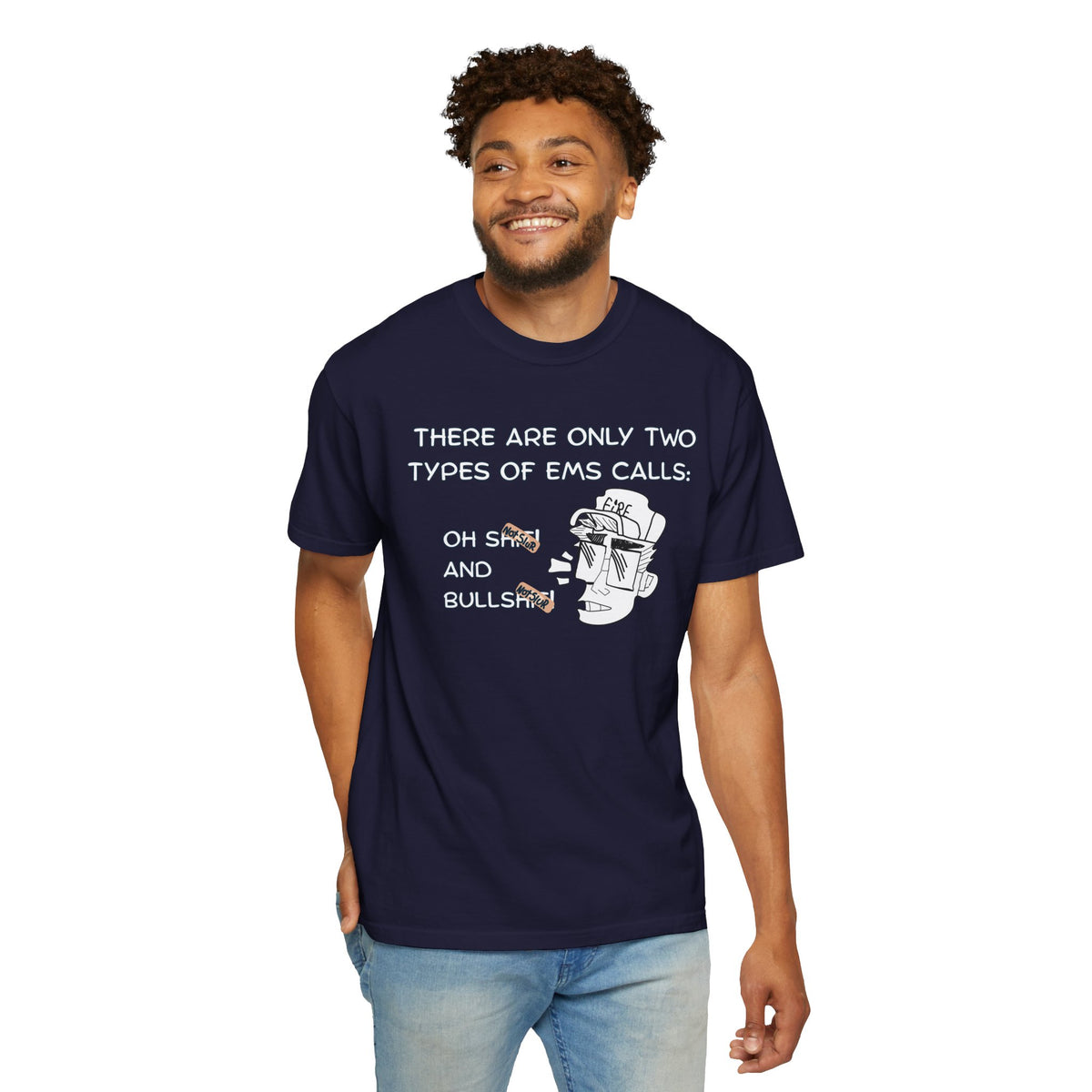
EMS Paramedic Funny T-Shirt | Two Types of Calls | EMT Dark Humor Gift for First Responders
EMS Paramedic Funny T-Shirt | Two Types of Calls | EMT Dark Humor Gift for First Responders
Auf Lager
- Kostenloser Versand
- 30 Tage Rückgaberecht (AGB gelten)
 Kundenbetreuung
Verfügbarkeit für Abholungen konnte nicht geladen werden
EMS Paramedic Funny T-Shirt | Two Types of Calls | Dark Humor Gift for EMTs & First Responders
If you have ever worked a shift on an ambulance, you already know the punchline before you even read it. This EMS paramedic funny t-shirt captures the unspoken truth every medic, EMT, and first responder lives by: there are really only two types of calls, and everyone in the field knows exactly what those two types are. Whether you are buying it for yourself after a long 24-hour shift or gifting it to the paramedic in your life who deserves a laugh, this shirt delivers the inside joke loud and clear while keeping outsiders completely in the dark. As far as unisex tees go, this one is built to earn a permanent spot at the top of the rotation.
Built on the legendary Comfort Colors 1717 platform, this unisex tee is made from heavyweight 100% ring-spun US cotton for that lived-in, broken-in feel from the very first wear. The relaxed fit and garment-dyed finish give it the look of a shirt you have had and loved for years. As a first responder t-shirt, it doubles as a badge of honor and a conversation starter among anyone who knows the job. Perfect for off-duty wear, station hangouts, or anywhere you want to quietly represent the chaos that is emergency medical services life.
Product Highlights
- Exclusive EMS dark humor inside joke design built for paramedics, EMTs, and first responders
- Printed on Comfort Colors 1717 heavyweight garment-dyed blank for a vintage, worn-in feel
- 6.1 oz/yd² (206.8 g/m²) heavyweight fabric for lasting durability and comfort
- Unisex tee with a relaxed fit that works for all body types
- Pre-shrunk 100% ring-spun US cotton, so what you order is what you get
- Available in 58 colors to match your station vibe or personal style
- Sewn-in label for a clean, comfortable finish against the skin
- Sizes S through 3XL to fit the whole ambulance crew
- Makes an ideal paramedic gift, EMT graduation present, or first responder appreciation item
- Great for hospital staff, ambulance services, fire-based EMS, and volunteer squads
- EU 2-year warranty included as per Directive 1999/44/EC
The Story Behind the Shirt: EMS Humor and the "Two Types of Calls" Culture
EMS dark humor has existed since the earliest days of organized pre-hospital care in the 1960s and 1970s, when the first modern paramedic programs were established in cities like Los Angeles and Miami. Crews working grueling shifts under high-stress, high-stakes conditions developed gallows humor as a coping mechanism long before the term "first responder mental health" entered the mainstream conversation. That humor became a badge of identity, a way to signal belonging to an incredibly demanding profession without ever having to explain it to outsiders.
The "two types of calls" framework is one of the oldest and most beloved of these inside jokes. In informal EMS culture, it refers to the near-universal experience that despite thousands of possible dispatch codes, the reality of the job tends to collapse into two broadly recognizable buckets every paramedic and EMT can name instantly. The specific punchline varies by crew and region, but the structure is universally understood across ambulance services worldwide. Over the last decade, this joke format has migrated onto social media, Reddit threads, and EMS humor communities, cementing its status as one of the defining inside jokes of the emergency medical services profession.
By putting this joke on a funny EMT shirt, we are not just selling a garment. We are preserving a small piece of EMS culture, honoring the millions of medics and technicians who have kept it alive on night shifts, back-of-ambulance conversations, and break-room bulletin boards for decades.
Size Guide
All measurements are in inches. A size tolerance of ±1.50 in applies to all sizes.
| Measurement | S | M | L | XL | 2XL | 3XL |
|---|---|---|---|---|---|---|
| Width (in) | 18.25 | 20.25 | 22.00 | 24.00 | 26.00 | 27.75 |
| Length (in) | 26.62 | 28.00 | 29.37 | 30.75 | 31.62 | 32.50 |
| Sleeve (center back, in) | 16.25 | 17.75 | 19.00 | 20.50 | 21.75 | 23.25 |
This shirt runs true to size in a relaxed fit. If you prefer a more fitted look, size down one. For a roomier, oversized feel, size up one.
Care Instructions
- 🧺 Machine wash: cold (max 30°C / 90°F)
- ❌ Do not bleach
- 🦺 Tumble dry: low heat
- 🦵 Iron, steam, or dry: low heat only
- ❌ Do not dry clean
Washing inside out helps preserve the print and the garment-dyed color longer. Avoid high heat at all stages to keep the fabric from shrinking or fading.
Orders are not eligible for returns or refunds. Exchanges are processed only in cases of manufacturing defects or damage incurred during shipping.
EU & UK Product Information
EU Representative: HONSON VENTURES LIMITED, gpsr@honsonventures.com
3 Gnaftis House, Flat 102, Mesa Geitonia, Limassol 4003, CY
Blank: Comfort Colors® 1717
Warranty: 2 years in EU and Northern Ireland as per Directive 1999/44/EC
Origin: Made in Honduras
The Perfect Gift for Any EMS Professional
Searching for a paramedic gift that goes beyond the standard coffee mug or keychain? This funny EMT shirt lands differently because it speaks the language. It requires zero explanation for anyone who has ridden in the back of a rig, but it keeps the punchline completely invisible to everyone else, which is precisely what makes it so satisfying to wear. Give it as a graduation gift for a new EMT, a birthday present for the medic who has seen everything, or a crew gift for the whole station to enjoy together.
As a first responder t-shirt built on Comfort Colors quality, it is also the kind of gift people actually reach for on their days off instead of hanging in the back of a closet. Pair it with a good pair of joggers after a night shift and it is exactly what recovering from 24 hours on an ambulance calls for. Stock it as a crew gift and watch the whole ambulance crew show up to the next shift wearing the same quiet inside joke.
Whether you are browsing EMS humor apparel for yourself, your partner, your partner on shift, or your entire volunteer squad, this design holds up as both a joke and a genuine quality garment. These unisex tees work for every body on the crew, and with 58 available color options you can match station colors, personal taste, or just pick whatever shade makes the punchline land hardest.
FAQ: EMS Life, Paramedic Culture & First Responder Reality
The "two types of calls" is one of the most enduring inside jokes in EMS culture. While the exact punchline varies by crew, region, and how dark the humor runs that particular shift, the joke generally refers to the way that thousands of possible dispatch codes and chief complaints tend to collapse, in practice, into two very recognizable categories that every experienced paramedic and EMT can name without hesitation. The joke thrives because it is simultaneously a comment on the repetitive nature of certain call types and an acknowledgment of the unpredictable intensity that defines the job. It is the kind of EMS dark humor that keeps crews functional during long, grueling shifts.
Research in occupational psychology consistently shows that first responders, including paramedics, EMTs, firefighters, and law enforcement, rely on humor as a primary coping mechanism for managing exposure to traumatic events. EMS dark humor is not callousness; it is a well-documented emotional regulation strategy that helps crews process difficult calls, maintain team cohesion under pressure, and return to full functioning after stressful scenes. Studies published in journals like Prehospital Emergency Care and the Journal of Traumatic Stress have highlighted how humor within emergency medical services teams can serve as a buffer against burnout and PTSD. It is also a form of professional identity, a way of signaling that you have been through the fire and come out the other side with your sanity more or less intact.
EMS humor has always lived in break rooms, ambulance bays, and hospital corridors, but the last decade saw it explode onto social media platforms including Reddit (particularly r/ems and r/poking_fun), TikTok, and Instagram. Accounts run by working medics and EMTs have amassed hundreds of thousands of followers by turning everyday call scenarios into relatable content for the emergency medical services community and giving civilians a sanitized but still honest window into the profession. Memes like the "two types of calls" format, "code 3 for a stubbed toe," and the classic "frequent flyer" jokes have gone viral repeatedly, spreading beyond the EMS community into broader first responder and healthcare circles. This visibility has also helped normalize conversations about paramedic mental health, burnout, and the emotional labor of pre-hospital care, making humor a gateway to more serious advocacy.
Both EMTs and paramedics are first responders trained in pre-hospital emergency care, but they operate at different certification levels with different scopes of practice. Emergency Medical Technicians (EMTs) complete roughly 120 to 150 hours of training and are authorized to perform basic life support (BLS) interventions: CPR, bleeding control, oxygen delivery, automated defibrillation, and basic airway management. Paramedics complete 1,200 to 1,800 or more hours of training, including clinical rotations, and can perform advanced life support (ALS): IV and IO access, medication administration, advanced airway management including intubation, cardiac rhythm interpretation, and surgical interventions in some systems. In many EMS systems, a paramedic and an EMT partner together on an Advanced Life Support unit, with the paramedic serving as the team lead on ALS-level calls.
Yes, and it has become one of the most discussed topics in the emergency medical services community. Studies consistently show that paramedics and EMTs experience PTSD at rates significantly higher than the general population, with some research suggesting rates of 15 to 25 percent, comparable to combat veterans. The combination of shift work, low pay relative to the physical and emotional demands, high call volume, and repeated exposure to trauma creates conditions for accelerated burnout. In recent years, organizations like the National EMS Management Association (NEMSMA), the American Ambulance Association, and state EMS offices have begun launching formal peer support programs, mental health hotlines, and critical incident stress management (CISM) frameworks specifically for first responders. Social media communities have also played a growing role in reducing stigma, with EMS humor serving as an entry point into broader conversations about the human cost of the profession.


Wird oft zusammen gekauft
-
Green Mage Everhood Plush | Fan Inspired Handmade 25cm Soft Collectible
Normaler Preis $47.15 AUDNormaler PreisStückpreis pro$0.00 AUDVerkaufspreis $47.15 AUD -
Lambert the Unholy Flock Leader Handmade Creepy Lamb Plush 26cm Indie Roguelike Cult Collectible
Normaler Preis $48.25 AUDNormaler PreisStückpreis pro$0.00 AUDVerkaufspreis $48.25 AUD -
Valko Plushie | Poseable Wire Skeleton Anime Handmade Fan Plush | Deep Space Hunter Cosplay Stuffed Toy 26cm
Normaler Preis $48.25 AUDNormaler PreisStückpreis pro$0.00 AUDVerkaufspreis $48.25 AUD -
Caped Ninja Football Superhero Plush Toy | Red Mask Sports Hero Handmade Plush 21cm
Normaler Preis $47.15 AUDNormaler PreisStückpreis pro$0.00 AUDVerkaufspreis $47.15 AUD


Vorgeschlagene Blogbeiträge:
Alle anzeigen-

In the Clear Moonlit Dusk Confirms Ending with ...
Mika Yamamori confirms In the Clear Moonlit Dusk manga ends with Volume 12 next spring. Here's what it means for the anime and live action film.
In the Clear Moonlit Dusk Confirms Ending with ...
Mika Yamamori confirms In the Clear Moonlit Dusk manga ends with Volume 12 next spring. Here's what it means for the anime and live action film.
-

+1 TNT Mining Codes, Best TNT Tier List & Sell ...
Grab the latest +1 TNT Mining codes for September 2026! Plus, unlock our ultimate TNT Tier List and Sell Calculator guide to maximize your Roblox grind.
+1 TNT Mining Codes, Best TNT Tier List & Sell ...
Grab the latest +1 TNT Mining codes for September 2026! Plus, unlock our ultimate TNT Tier List and Sell Calculator guide to maximize your Roblox grind.
-

Lift a Cube(Roblox): How to Get Your First Mill...
Struggling to lift heavy? Discover the exact pet strategies and rebirth methods to hit the Lift a Cube Roblox 1 Million Kg milestone fast. Read our guide!
Lift a Cube(Roblox): How to Get Your First Mill...
Struggling to lift heavy? Discover the exact pet strategies and rebirth methods to hit the Lift a Cube Roblox 1 Million Kg milestone fast. Read our guide!
-

Monochrome: Roblox Scariest Game Ever! What to ...
New to MONOCHROME on Roblox? Learn what the game is, how to find four keys and the elevator code, survive the monster, and escape — complete beginner guide.
Monochrome: Roblox Scariest Game Ever! What to ...
New to MONOCHROME on Roblox? Learn what the game is, how to find four keys and the elevator code, survive the monster, and escape — complete beginner guide.


Verifizierte Google-Rezensionen
Das sagen unsere Kunden