


Peacock Plush - Vibrant Fan Tail Peacock Stuffed Animal | Choose Blue or Green | 25cm
Peacock Plush - Vibrant Fan Tail Peacock Stuffed Animal | Choose Blue or Green | 25cm
Auf Lager
- Kostenloser Versand
- 30 Tage Rückgaberecht (AGB gelten)
- Kundenbetreuung
Verfügbarkeit für Abholungen konnte nicht geladen werden
Peacock Plush - Vibrant Fan Tail Peacock Stuffed Animal (Choose Blue or Green)
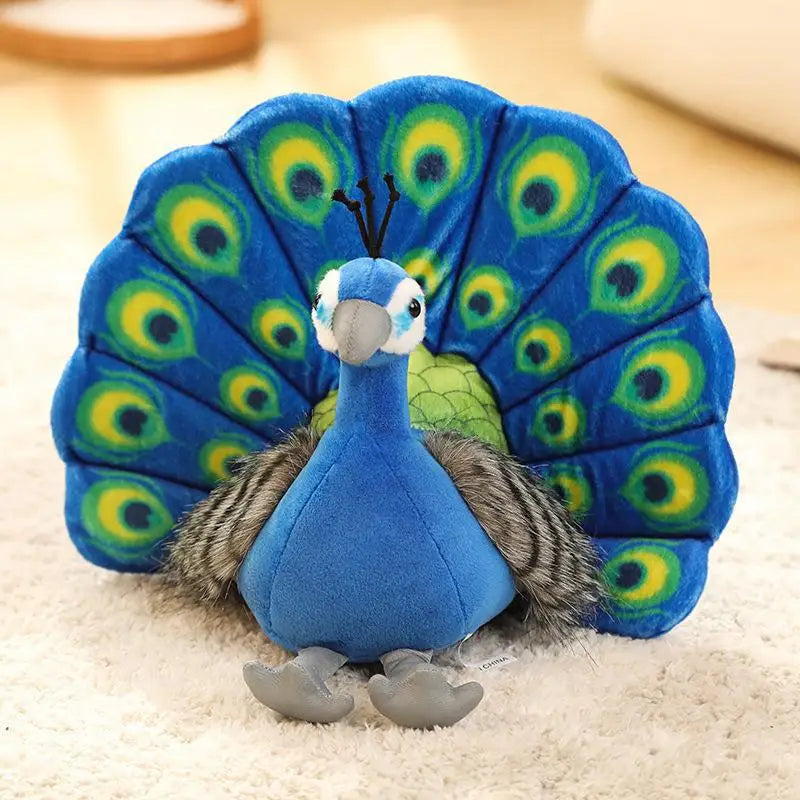
Bring the breathtaking spectacle of a courtship display right into your home with this stunning peacock plush. Designed with a structured, upright fan tail plush that mimics a real peacock in full display, this peacock stuffed animal is a showstopper whether you prop it on a shelf, gift it to a nature lover, or add it to your growing wildlife stuffed animal collection. Available in vivid Blue or lush Green, the choice is yours.
This peacock plushie captures the dramatic elegance of one of the world's most iconic birds. With its full fan spread frozen in a permanent display pose, it is as much a piece of peacock room decor as it is a classic bird plush toy. Whether you are drawn to regal Blue or the earthy richness of Green, both variants deliver the same bold visual impact that makes the peacock so universally admired.
The Peacock: A Bird Celebrated Across Civilisations
The peacock, formally known as the male Indian peafowl (Pavo cristatus), originates from the Indian subcontinent and has been revered across cultures for thousands of years. Ancient Hindu mythology links the peacock directly to the divine, with the bird appearing as the sacred vehicle of Lord Kartikeya and the feather of the peacock serving as one of the most recognised symbols of Lord Krishna. The association with Krishna is so powerful that peacock feathers are sometimes used as a stand-in for the deity himself in devotional art.
In Greek mythology, the striking "eyes" that dot a peacock's tail feathers are said to be the eyes of the hundred-eyed giant Argus, placed there by the goddess Hera after his death as a mark of her eternal watchfulness. Roman culture adopted this imagery to project divine authority, and Roman emperors placed peacock motifs on coins and mosaics to signal their semi-divine status.
In Chinese imperial culture, peacock feathers were exclusive to the emperor and nobility. During the Ming and Qing dynasties, peacock motifs adorned the formal robes of civil officials as a direct marker of rank and honour. The famous Peacock Throne, built in the early 17th century for Shah Jahan, featured sculpted peacocks encrusted in gold and jewels - perhaps the most extravagant use of peacock imagery in recorded history.
Across Buddhism, the peacock is a symbol of purity and transformation, believed to consume poisonous plants and convert them into radiant plumage - a metaphor for turning negativity into enlightenment. In Persian tradition, the peacock represented immortality. In early Christianity, the bird's annual shedding and regrowth of tail feathers became a metaphor for resurrection and eternal life.
Few creatures in the natural world carry this weight of cross-cultural meaning. This peacock plush distils centuries of that symbolism into a soft, displayable form that fits in any modern home.
Why Choose This Peacock Plushie?
This decorative plush is built for impact. The structured fan tail is the defining feature: rather than lying flat or drooping to the side, the tail fans outward and upward, replicating the exact posture a real peacock adopts when it wants to be seen. It is the kind of nature plush toy that earns a dedicated display spot rather than being tucked away in a toy box.
With two colourways on offer, you can pick the version that suits your space or the recipient's personality. The Blue Peacock Plush evokes the classic iridescent plumage most people picture when they think of a peacock. The Green Peacock Plush offers a slightly earthy, rainforest-inspired alternative that pairs beautifully with botanical decor styles. Both share the same quality construction, including the signature upright fan tail plush form that sets this design apart from flat-bodied bird plushies.
Product Highlights
- Peacock Plush with upright, structured fan tail - posed in full courtship display
- Choose from two vivid colourways: Blue Peacock Plush or Green Peacock Plush
- 25 cm standing height - ideal desk, shelf, or mantle display size
- Filled with PP Cotton for a soft, lightweight feel with shape retention
- Plush fabric exterior - smooth to the touch with rich colour saturation
- Suitable as a decorative plush, gift, or wildlife stuffed animal collectible
- Makes an eye-catching piece of peacock room decor in any setting
- A standout exotic bird plush for nature lovers, collectors, and decor enthusiasts
- Appropriate for display by adults and older children (not intended as an infant toy)
Size Guide
| Measurement | Dimension | Notes |
|---|---|---|
| Standing Height | 25 cm | Measured from base to top of fan tail |
| Fan Tail Spread | Structured upright | Fan tail held in fixed display position |
| Filling | PP Cotton | Lightweight, shape-retaining polyester fill |
| Material | Plush fabric | Smooth, vibrant exterior |
| Colour Options | Blue / Green | Select variant before adding to cart |
Care Instructions
- Surface spot clean only - do not submerge in water or machine wash
- Use a damp cloth with mild soap to gently wipe affected areas
- Air dry completely before returning to display - keep away from direct heat sources
- Do not tumble dry, iron, or bleach
- Store away from prolonged direct sunlight to preserve colour vibrancy
- Reshape the fan tail gently by hand if it shifts during transport or storage
The Perfect Gift for Nature Lovers and Decor Enthusiasts
Whether you are shopping for a bird enthusiast, a collector of wildlife stuffed animals, or someone who simply appreciates beautifully designed nature plush toys, this peacock plushie delivers on every front. Its sculptural fan tail makes it unlike any ordinary stuffed bird - it is a statement piece that draws the eye and invites conversation.
As peacock room decor, it pairs effortlessly with botanical prints, earthy textures, global-inspired interiors, and jewel-toned colour schemes. As a bird plush toy, it brings tactile satisfaction and visual delight in equal measure. As an exotic bird plush, it holds its own among serious plush collections alongside other wildlife species.
Gift it for birthdays, housewarmings, nature-themed occasions, or simply as a treat for someone who deserves something extraordinary. This decorative plush arrives ready to impress from the moment it is unboxed.
FAQ: Peacocks - Beauty, Symbolism, and the Bird Behind the Plush
The dramatic fan display is a courtship behaviour performed exclusively by male peacocks (known as peacocks or peafowl), aimed at attracting female peahens. The tail feathers - technically called the train rather than a true tail - can span up to 1.8 metres and account for roughly 60 percent of the bird's total body length. Each feather is tipped with an iridescent "eye" (ocellus) that shimmers between blue, green, and gold depending on the angle of light. During a display, the male vibrates the entire fan rapidly to create a shimmering visual and even a low-frequency sound that researchers believe females can detect. Interestingly, studies suggest peahens do not simply choose males with the most feathers - they appear to prefer males whose eyes are clustered toward the top of the fan, a subtle quality signal that is difficult for lower-quality males to fake.
There are three recognised species of peafowl in the world. The Indian peafowl (Pavo cristatus) is the most familiar species, known for its brilliant blue-and-green iridescent plumage and the one most people picture when they say "peacock." The male has a vivid blue neck and breast. The Green peafowl (Pavo muticus) is native to Southeast Asia and is quite different in appearance, with intricate green-scaled feathering covering most of the body and a distinctive upright crest. The Green peafowl is currently classified as Endangered due to habitat loss and hunting, making it a less common sight in zoos and collections. A third species, the Congo peafowl (Afropavo congensis), is found in central Africa and has a notably different appearance from both Asian species. The blue-and-green colourway divide in this peacock plush loosely reflects this real-world distinction between the two most recognised Asian species.
India designated the Indian peafowl as its national bird in 1963, citing its deep roots in Indian culture, mythology, and art. The peacock appears across thousands of years of Hindu scripture and visual art. It is the sacred vehicle (vahana) of Kartikeya, the god of war, and Lord Krishna is almost always depicted wearing a single peacock feather in his crown. According to one well-known story, Krishna played his flute so beautifully in the forests of Vrindavan that the peacocks began to dance and shed their feathers in ecstasy, gifting him the iconic plume he wears. The bird also appears as a motif in Mughal architecture, most famously on the legendary Peacock Throne of Shah Jahan. Beyond religion, the peacock's arrival at the start of the Indian monsoon season connected it culturally to rain, renewal, and abundance - reinforcing its status as an auspicious creature across multiple Indian traditions.
Peacock feathers are one of the most studied examples of structural colour in the natural world. The shimmering blues and greens are not produced by pigment at all. Instead, each feather barbule contains a precisely arranged array of melanin granules and air-filled spaces that form a two-dimensional photonic crystal. This microscopic structure interferes with light waves, selectively reflecting specific wavelengths (primarily blue and green) while absorbing others. The colour appears to shift as the viewing angle changes because the interference pattern changes with the angle of incoming light. This is why peacock feathers flash and shimmer as the bird moves - a property that pigment-based colours cannot replicate. Scientists have drawn inspiration from this architecture in developing optical coatings, anti-counterfeiting technologies, and even structural colour fabrics that do not fade over time.
Yes, peacocks can fly, and they are surprisingly capable fliers despite the extraordinary weight and drag of the male's train. In the wild, peacocks roost in tall trees at night to avoid ground predators, and they use explosive short-distance flight to escape danger. A startled peacock can launch itself vertically and clear most obstacles in its environment. Their top speed in flight is estimated at around 16 km/h (10 mph), and they can cover considerable horizontal distance in a single burst. On the ground, peacocks are quick runners, capable of sprinting at roughly 16 km/h as well. The train is shed naturally each year after the mating season, allowing the male a period of greater flight capability before the feathers regrow ahead of the next display cycle. This annual shedding - and the full regrowth that follows - became a central reason why peacocks were adopted as symbols of resurrection and renewal across multiple world religions.


Wird oft zusammen gekauft
-
Kawaii Plush Potted Plants with Dangle Legs | Smiling Cactus Sunflower Calla Lily Rose Stuffed Flower Plushie Decor 25-30cm
Normaler Preis Von $52.95 AUDNormaler PreisStückpreis pro$0.00 AUDVerkaufspreis Von $52.95 AUD -
Kawaii Pastel Alien Plush | Cute Long Leg Cosmic Galaxy Stuffed Animal | 3 Colors 4 Sizes
Normaler Preis Von $57.25 AUDNormaler PreisStückpreis pro$0.00 AUDVerkaufspreis Von $57.25 AUD -
Cute Lifelike Duck Plush 16cm Realistic White Goose Stuffed Animal Handmade Kawaii Duck Toy
Normaler Preis $52.95 AUDNormaler PreisStückpreis pro$0.00 AUDVerkaufspreis $52.95 AUD -
Smiling Grapes Plush | Kawaii Cute Fruit Stuffed Animal | Aesthetic Room and Car Hanging Decor | S 20cm L 26cm
Normaler Preis Von $52.95 AUDNormaler PreisStückpreis pro$0.00 AUDVerkaufspreis Von $52.95 AUD


Vorgeschlagene Blogbeiträge:
Alle anzeigen-

Sell Fries! [Anomaly] Roblox Guide: Anomalies, ...
Sell Fries Roblox guide: how to make fries fast, every anomaly and its fix, the hidden key route, upgrades and classes. Read before your first night shift.
Sell Fries! [Anomaly] Roblox Guide: Anomalies, ...
Sell Fries Roblox guide: how to make fries fast, every anomaly and its fix, the hidden key route, upgrades and classes. Read before your first night shift.
-

PIPES Roblox Guide: All 10 Nights, Monsters and...
PIPES Roblox guide: how the 10 nights work, what you do in the pipe mazes, the 14 monsters, Custom Night and co-op tips. Read before your first shift.
PIPES Roblox Guide: All 10 Nights, Monsters and...
PIPES Roblox guide: how the 10 nights work, what you do in the pipe mazes, the 14 monsters, Custom Night and co-op tips. Read before your first shift.
-

-


Verifizierte Google-Rezensionen
Das sagen unsere Kunden