


Realistic Sea Lamprey Eel Plush 52cm | Handmade Lifelike Deep Sea Fish Stuffed Animal | Ocean Collectible
Realistic Sea Lamprey Eel Plush 52cm | Handmade Lifelike Deep Sea Fish Stuffed Animal | Ocean Collectible
Auf Lager
- Kostenloser Versand
- 30 Tage Rückgaberecht (AGB gelten)
- Kundenbetreuung
Verfügbarkeit für Abholungen konnte nicht geladen werden
Realistic Sea Lamprey Eel Plush 52cm | Handmade Lifelike Deep Sea Stuffed Animal
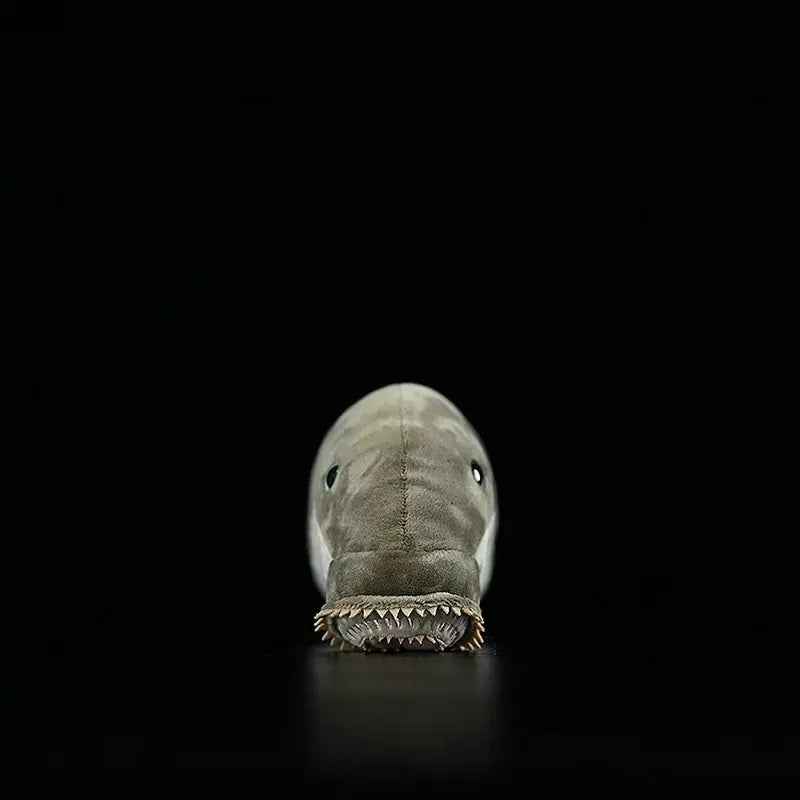
Welcome one of Earth's oldest survivors into your collection. This Sea Lamprey Eel Plush is among the most anatomically accurate ocean creature plush collectibles available today. Measuring a full 52 centimeters from tip to tail, this spectacular sea lamprey plush captures everything that makes this ancient creature so intensely fascinating: the elongated serpentine form, the smooth cylindrical body, and the iconic funnel-shaped oral disc ringed with rows of carefully crafted simulated teeth.
This eel plush is far from your average stuffed sea creature. It is a faithful tribute to a living fossil that has both terrified and captivated humanity for generations, now reimagined as a handmade plush collectible worthy of any serious collection. Whether you are a dedicated marine biology enthusiast, a fan of extraordinary ocean life, or someone searching for a genuinely unique gift, this jawless fish stuffed animal delivers an experience unlike anything else on the market. If you are looking for the perfect marine biology gift that nobody else will think of, or a creepy cute plush that genuinely fascinates everyone who sees it, this is the piece you have been searching for.
The Sea Lamprey: 360 Million Years of Prehistoric Mastery
The sea lamprey (scientific order Petromyzontiformes) is one of the oldest living vertebrates on Earth. Fossil evidence places this creature and its close relatives on this planet for well over 360 million years, making it older than the dinosaurs by an enormous margin. The design proved so effective from the very beginning that evolution had almost no reason to change it across hundreds of millions of years of geological history, making the sea lamprey one of nature's most extraordinary examples of adaptive longevity.
Native to the Atlantic Ocean and parts of the Mediterranean Sea, the sea lamprey is best known for its extraordinary circular oral disc: a powerful suction-based mouth packed with concentric rings of sharp teeth. Unlike virtually all modern fish, the sea lamprey has no jaw whatsoever. Instead, it attaches to host fish using this terrifying oral structure, then uses a rasping tongue-like mechanism to work through scales and skin, secreting anticoagulant compounds to keep the wound open while feeding on blood and tissue for extended periods that sometimes last weeks at a time.
This prehistoric fish plush celebrates a creature whose origins long predate the age of reptiles. The sea lamprey has outlasted countless species across multiple mass extinction events and continues to thrive in both its native Atlantic habitat and in freshwater ecosystems it colonized as an invasive species. That story of survival across deep geological time is a significant part of what makes the sea lamprey such an enduring fascination for naturalists, scientists, and collectors alike.
In the early 20th century, the construction of shipping canals in North America opened a pathway for sea lampreys to enter the Great Lakes for the first time. With no natural predators in these freshwater environments and an abundant supply of native host fish, sea lamprey populations grew at an extraordinary rate. A single adult sea lamprey can destroy more than 40 pounds of fish during its parasitic adult stage. The devastation to commercially vital fish species including lake trout and whitefish prompted the formation of the Great Lakes Fishery Commission and launched conservation programs that remain active to this day.
On social media and online nature communities, the sea lamprey achieved a kind of viral celebrity as one of nature's most visually alarming creatures. Images and videos of the lamprey's circular toothed oral disc spread widely across Reddit, TikTok, and YouTube, earning it an honored position in the broader internet tradition of fascination with strange and terrifying natural creatures. It is precisely this cultural moment that brought the concept of a sea lamprey plush to life: the idea of taking one of nature's most unsettling designs and making it soft, approachable, and genuinely wonderful to own.
Product Features and Highlights
What Makes This Sea Lamprey Eel Plush Stand Apart
- Highly Accurate Design: This realistic sea animal plush is modeled faithfully after the real sea lamprey (order Petromyzontiformes), complete with the elongated body silhouette and the unmistakable funnel-shaped oral disc with simulated tooth ring detailing.
- Premium Plush Fabric: Crafted from high quality plush material that replicates the smooth texture of real lamprey skin while remaining genuinely soft and enjoyable to handle.
- Hypoallergenic PP Cotton Filling: Stuffed with premium PP cotton for a firm yet compressible feel that holds its shape reliably through years of display and handling.
- Handmade Craftsmanship: Every lamprey stuffed toy is assembled by hand, ensuring a level of detail and care in construction that factory production simply cannot replicate.
- Impressive 52cm Length: At 52 centimeters (approximately 20.5 inches), this is a substantial and display worthy piece that commands immediate attention on any surface it occupies.
- Safe Materials: Made from materials free of toxic substances. Recommended for ages 3 and above, with adult supervision advised for the youngest children.
- Remarkable Collectible: A standout ocean animal stuffed animal for fans of deep sea biology, unusual nature content, and genuinely distinctive plush collectibles.
- Outstanding Gift Option: An exceptional marine biology gift for science students, ocean enthusiasts, nature educators, and anyone who loves the extraordinary breadth of marine life.
- Perfectly Displayable: A superb addition to any sea creature plush toy collection, and equally impressive as a standalone centerpiece on a desk, shelf, or display cabinet.
Product Specifications
This deep sea fish plush is built for collectors and display enthusiasts who value both anatomical accuracy and genuine craftsmanship. Full specifications are listed below:
- Character: Sea Lamprey (Petromyzontiformes)
- Length: 52 cm (approximately 20.5 inches)
- Material: High quality plush fabric
- Filling: PP Cotton (hypoallergenic)
- Type: Stuffed Animal and Plush Collectible
- Construction: Handmade
- Recommended Age: 3 years and above
Size Guide
Use the reference table below to understand the dimensions of this eel plush before purchasing. As a handmade item, slight variations may exist between individual pieces.
| Measurement | Centimeters | Inches (approx.) |
|---|---|---|
| Total Body Length | 52 cm | ~20.5 in |
| Body Diameter (widest point) | ~6 cm | ~2.4 in |
| Oral Disc Diameter | ~4 cm | ~1.6 in |
Care Instructions
Keeping Your Sea Creature Plush Toy in Excellent Condition
- Surface Cleaning: For light dust or minor surface marks, use a soft cloth that is slightly damp to gently wipe the plush exterior. Allow to air dry fully before returning to display.
- Spot Cleaning: For stains, apply a small amount of mild soap to a damp cloth and press it gently against the affected area. Avoid scrubbing. Follow with a clean damp cloth to remove soap residue, then air dry completely.
- No Machine Washing: Machine washing is not recommended for this realistic sea animal plush, as agitation can distort its shape and damage the detailed handmade stitching.
- No Tumble Drying: Heat exposure can damage the plush fabric and cause the PP cotton filling to bunch unevenly. Always air dry in a place with good airflow, away from direct sunlight.
- No Bleach or Harsh Chemicals: Strong cleaning agents will break down the fabric and fade the color. Use only mild, gentle solutions when cleaning is necessary.
- Storage: Store this jawless fish stuffed animal in a cool and dry location away from prolonged direct sunlight to preserve fabric color and quality over the long term.
- Handle with Care: As a handmade collectible display piece, keeping this item away from sharp objects and rough surfaces will preserve its quality for years to come.
Why Collectors and Enthusiasts Choose This Ocean Animal Stuffed Animal
There are plush toys and then there are pieces that make people genuinely stop and stare. This creepy cute plush belongs firmly in the second category. The sea lamprey's reputation as one of the internet's most visually captivating nightmare creatures translates with remarkable power into plush form. That iconic oral disc, rendered in soft fabric, still draws immediate attention from everyone who encounters it, while the huggable structure makes it approachable in a way the real animal absolutely is not.
This sea creature plush toy is equally at home as part of a serious marine biology collection, a curiosity shelf display, or a centerpiece in a deep sea creature grouping. It pairs beautifully alongside other realistic sea animal plush pieces or stands powerfully on its own. The lamprey stuffed toy also makes an exceptional and genuinely memorable gift for anyone who studies the natural world, teaches marine science, or simply loves owning things that are unlike anything else they have ever seen.
For the collector who already owns every common ocean animal and wants to take their collection somewhere genuinely adventurous, this ocean animal stuffed animal represents exactly that next level of discovery. For the student of natural history who wants their space to reflect a love of the deep and ancient past, this prehistoric fish plush is the perfect expression of that passion. And for anyone who encountered a sea lamprey video online and immediately thought they needed one as a plush, here is exactly that opportunity fulfilled.
The deep sea fish plush you purchase here is not a mass produced novelty. It is a handmade piece of genuine quality, built to display, gifted to impress, and chosen by people who understand that the most extraordinary things in the natural world deserve the most extraordinary representation on their shelves.
FAQ: Sea Lamprey Facts and Trending Questions
Sea lampreys are not considered a serious direct threat to humans under typical conditions. While their circular toothed oral disc is visually alarming, sea lampreys naturally target fish as hosts rather than people. There are occasional documented reports of sea lampreys attaching to swimmers in waters with very high lamprey populations, but serious injury from such encounters is rare. Their primary ecological danger is directed at other fish species. In places like the North American Great Lakes, invasive sea lamprey populations caused the near collapse of native fish species over several decades. To a lake trout, a sea lamprey is a lethal predator. To a human swimmer, it is an unsettling but typically fleeting and rarely harmful encounter.
The sea lamprey lineage extends back more than 360 million years, making these creatures older than the first dinosaurs by a substantial margin. What earns them the title of living fossils is not just their extraordinary age but how little their design has changed across that immense span of time. Fossil specimens recovered from ancient rock formations show a body plan that is virtually identical to modern sea lampreys. The jawless structure, the oral disc, the cartilaginous skeleton and the overall anatomy of today's sea lampreys closely mirror those preserved in stone hundreds of millions of years ago. In evolutionary terms, the sea lamprey developed an effective design very early in its history and simply never needed to revise it.
Sea lampreys entered the Great Lakes through the Welland Canal in the early 20th century, gaining access to a vast freshwater ecosystem where they faced no natural predators and found an abundant supply of host fish. In their native Atlantic environment, natural population controls keep lamprey numbers stable. In the Great Lakes, those checks did not exist. Lamprey populations surged rapidly, and the populations of commercially important fish including lake trout and whitefish collapsed dramatically as a result. A single adult sea lamprey can destroy over 40 pounds of fish across its parasitic adult life stage, and with hundreds of thousands of lampreys in the system, the cumulative damage was enormous. This ecological crisis led to the establishment of the Great Lakes Fishery Commission, which today coordinates ongoing lamprey control through targeted lampricides, physical barriers on spawning rivers, and trapping programs.
The sea lamprey feeds through a process that is as efficient as it is disturbing. It attaches to a host fish using its circular oral disc, securing its grip with rings of sharp teeth. It then uses a rasping tongue structure to work through the host's skin, secreting a powerful anticoagulant to prevent the wound from clotting. The lamprey feeds on blood, bodily fluids, and tissue for extended periods, sometimes remaining attached to a single host for weeks. The host fish frequently dies or is left severely weakened. As for the visual impact of that circular mouth: it works so powerfully on the human imagination because it contains nothing familiar. No jaw, no recognizable face, no standard vertebrate structure. Just a perfectly circular arrangement of teeth surrounding an open void. That alien quality is a large part of why sea lamprey content spread so widely across social media and nature communities online.
Sea lampreys and eels share a superficially similar elongated, serpentine body shape, which is why the two creatures are sometimes confused in casual descriptions. In biological terms, however, they are entirely unrelated animals separated by hundreds of millions of years of independent evolution. Eels are true bony fish (class Actinopterygii) with jaws, a standard bony skeleton, and paired fins. Sea lampreys, by contrast, belong to the ancient jawless vertebrate lineage (class Petromyzontida). They have no bones at all, only cartilage. They possess no jaw and no paired fins. Their circular oral disc is a structure found in no other living vertebrate group. The resemblance between sea lampreys and eels is a textbook example of convergent evolution: two completely separate lineages arriving independently at a similar body form because that elongated shape is hydrodynamically advantageous in an aquatic environment.


Wird oft zusammen gekauft
-
Realistic Walrus Plush 30cm | Lifelike Walrus Stuffed Animal with Tusks and Whiskers | Handmade Sea Animal Toy
Normaler Preis $53.95 AUDNormaler PreisStückpreis pro$0.00 AUDVerkaufspreis $53.95 AUD -
Military Tank Plush Toy | Camo Commander Soft Camouflage Stuffed Animal for Kids | 22cm & 32cm
Normaler Preis Von $52.95 AUDNormaler PreisStückpreis pro$0.00 AUDVerkaufspreis Von $52.95 AUD -
Realistic Redtail Catfish Plush Lifelike Amazon River Monster Fish Stuffed Animal Handmade Plush 14cm
Normaler Preis $47.25 AUDNormaler PreisStückpreis pro$0.00 AUDVerkaufspreis $47.25 AUD -
Realistic Sea Lamprey Eel Plush 52cm | Handmade Lifelike Deep Sea Fish Stuffed Animal | Ocean Collectible
Normaler Preis $63.95 AUDNormaler PreisStückpreis pro$0.00 AUDVerkaufspreis $63.95 AUD


Vorgeschlagene Blogbeiträge:
Alle anzeigen-

Jester Dragon Adopt Me: How to Get for Free + T...
Get the Jester Dragon in Adopt Me Halloween 2026 for free, fuse a Neon, and trade smart. Full guide with current values, step-by-step methods, and trading tips.
Jester Dragon Adopt Me: How to Get for Free + T...
Get the Jester Dragon in Adopt Me Halloween 2026 for free, fuse a Neon, and trade smart. Full guide with current values, step-by-step methods, and trading tips.
-

Why Am I a Wolf Anime: Where to Watch the Trimz...
A giant wolf raises a moon-sent bunny who thinks she's a predator. Here's what the Why Am I a Wolf anime is about and where to watch it free on...
Why Am I a Wolf Anime: Where to Watch the Trimz...
A giant wolf raises a moon-sent bunny who thinks she's a predator. Here's what the Why Am I a Wolf anime is about and where to watch it free on...
-

I Reincarnated Into a Single-Celled Organism An...
I Reincarnated Into a Single-Celled Organism anime key art, a glowing evolved cell organism from the Trimz series by Shadow Damned
I Reincarnated Into a Single-Celled Organism An...
I Reincarnated Into a Single-Celled Organism anime key art, a glowing evolved cell organism from the Trimz series by Shadow Damned
-

99 Nights In The Forest Halloween Update: All o...
The Ram smashed Happyy into pieces for 99 Nights in the Forest's Halloween update. Here's where each body part spawns and how to beat the Ram.
99 Nights In The Forest Halloween Update: All o...
The Ram smashed Happyy into pieces for 99 Nights in the Forest's Halloween update. Here's where each body part spawns and how to beat the Ram.


Verifizierte Google-Rezensionen
Das sagen unsere Kunden