


Crystal Types T-Shirt - Metallic Resinous Vitreous Mineral Graphic Tee | Geology Gift
Crystal Types T-Shirt - Metallic Resinous Vitreous Mineral Graphic Tee | Geology Gift
En existencias
- Free Shipping
- 30 Days Return(T&C applies)
 Customer Support
No se pudo cargar la disponibilidad de retiro
Crystal Types T-Shirt - Metallic, Resinous, and Vitreous Mineral Graphic Tee
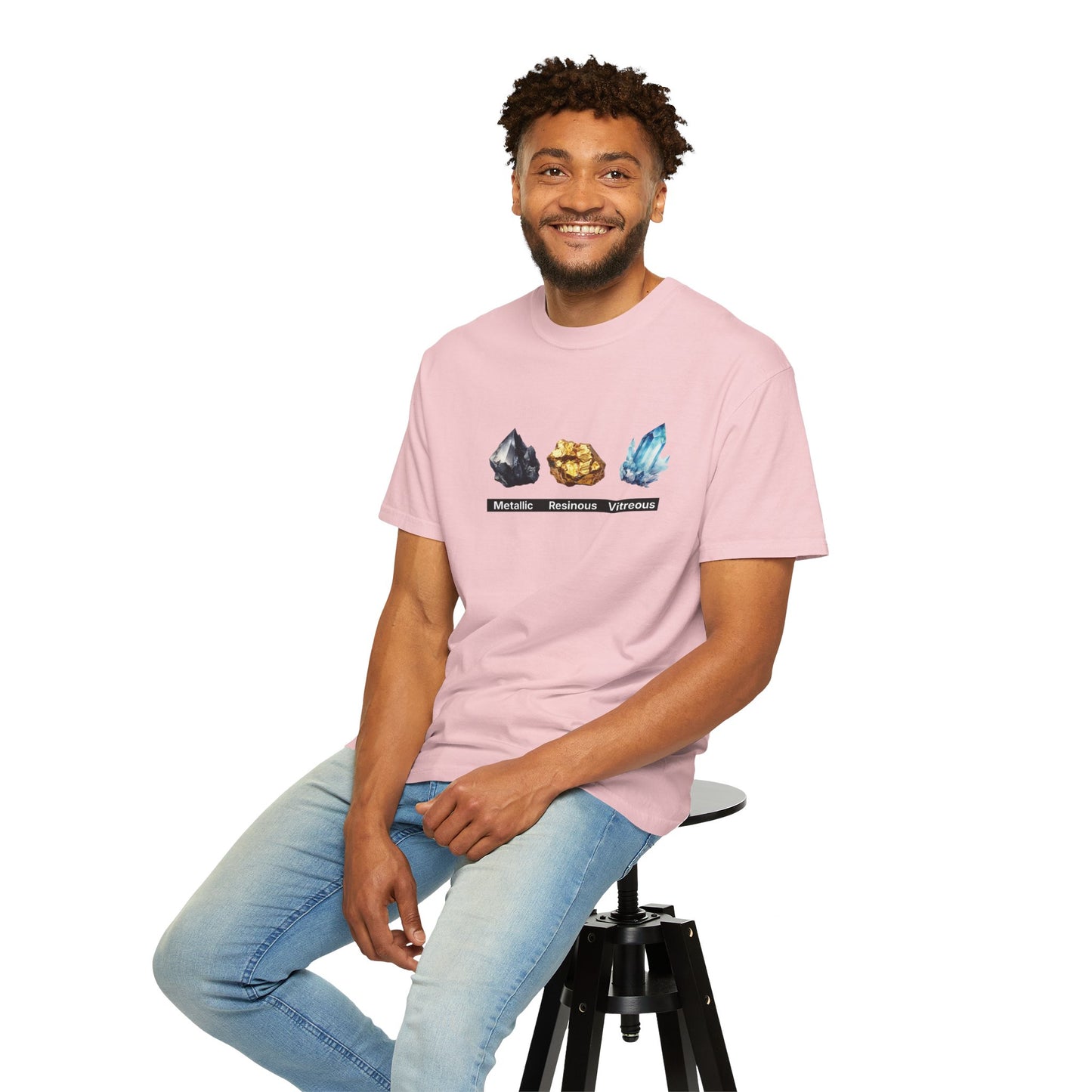
Some shirts just hang there. This one invites a second look. The Crystal Types T-Shirt places three beautifully rendered mineral illustrations - metallic, resinous, and vitreous - across the chest like specimens arranged in a geology graphic tee display case. It is the kind of quiet, considered design that rewards curiosity: the kind worn by people who slow down in natural history museums, who have rocks on their windowsills, who find beauty in the structure of things.
Built on the legendary Comfort Colors 1717 base, this heavyweight cotton tee is garment-dyed after construction, giving it a worn-in softness and subtle color variation from day one. Whether you are heading out for a rockhounding weekend, layering it under a field jacket, or simply reaching for your most comfortable shirt, this crystal luster tee moves with you through all of it.
What Makes This Geology T-Shirt Different
The crystal luster graphic tee is designed for those who collect moments as much as minerals. The chest print features three of the most visually distinct crystal luster types found in the natural world - metallic, with its mirror-bright reflectivity; resinous, with its warm, amber-like glow; and vitreous, the glassy sheen found in quartz and countless beloved gemstones. Together, they form a compact field guide worn on the body.
The Comfort Colors 1717 construction means the shirt is 100% ring-spun US cotton, pre-shrunk, and built to last. Its garment-dyed finish gives every piece a slightly unique character - no two are exactly alike. The relaxed fit, tubular knit, and double-needle stitching make it as durable as it is comfortable, a true everyday science-themed apparel staple for the intellectually inclined.
Product Highlights
- Crystal Types Print: Illustrative chest graphic featuring metallic, resinous, and vitreous crystal luster types - a wearable mineral field reference
- Comfort Colors 1717 Base: The most trusted blank in premium geology graphic tee culture, known for unmatched softness and character
- Garment-Dyed Finish: Post-construction dyeing delivers a lived-in feel and gentle color variation right out of the packaging
- Heavyweight 6.1 oz/yd2 Fabric: 100% ring-spun US cotton, pre-shrunk and built for long-term wear
- Relaxed Fit: Generous, comfortable silhouette ideal for layering or wearing solo
- Tubular Construction: Side-seam-free build for cleaner drape and reduced textile waste
- Double-Needle Stitching: Reinforced seams that hold their shape through years of washing and wearing
- Sewn-In Label: Clean interior finish with no printed tag irritation
- Sizes S to 3XL: Full size range to suit every body
- Science-Themed Apparel: A thoughtful gift for geology lovers, mineral collectors, gemstone enthusiasts, and curious minds
The Science Behind the Design: Crystal Luster Types Explained
Crystal luster is one of the oldest and most reliable tools in a mineralogist's kit. Long before spectroscopy or chemical testing, geologists classified minerals by the way light interacted with their surfaces - a quality called luster. This shirt celebrates three of the most iconic categories in that system.
Metallic Luster
Metallic luster describes minerals that interact with light the way polished metals do: reflective, opaque, and almost mirror-bright. Galena, pyrite, and native gold are classic examples. These minerals have fascinated humans for thousands of years - pyrite, known as "fool's gold," was carried by prospectors during the California Gold Rush. Metallic minerals are typically high in density and often form in hydrothermal veins where superheated water deposits dissolved metals as it cools. Their reflective quality made them among the first substances humans used as mirrors, and their association with wealth shaped the course of civilizations.
Resinous Luster
Resinous luster describes minerals with a warm, amber-like surface quality reminiscent of dried tree resin or polished amber itself. Sphalerite, sulfur, and certain garnets display this glow. The term originates from the organic resins exuded by ancient trees - substances that could themselves become minerals over millions of years through a process called polymerization, forming the amber we prize today. Resinous minerals often have a non-metallic, slightly greasy quality to their surface that gives them a warm, inviting depth, making them favorites in mineral collections and educational displays.
Vitreous Luster
The most common luster type in the mineral kingdom, vitreous luster refers to the glassy, transparent or translucent sheen seen in quartz, topaz, tourmaline, and the majority of silicate minerals. The name comes from the Latin "vitrum," meaning glass - the same root as "vitreous humor" in the human eye. Quartz, one of the most abundant minerals on Earth's crust, is the canonical example. Vitreous minerals have shaped human history through their use in lenses, windows, jewelry, and electronics. Quartz in particular underpins modern timekeeping and computing. The vitreous luster seen in fine gemstones is part of what makes them so captivating: the way they catch and scatter light speaks directly to our evolved visual instincts.
Designed for the Geology Lover, Worn by Everyone
This mineral graphic tee sits at the intersection of science-themed apparel and everyday wardrobe staple. It works as a gift for the geology lover in your life - whether they are a university student in an earth sciences program, a passionate amateur rockhound, a gemstone collector, or simply someone who finds the natural world endlessly interesting. The understated, label-style illustration keeps the design wearable in almost any context: not a novelty item, but a piece of clothing that quietly signals something about who you are and what you find worth knowing.
Pair it with cargo pants and boots for a day in the field. Tuck it under a flannel for an autumn hike. Wear it to the natural history museum, the university library, or a weekend market. The crystal types shirt adapts to wherever curiosity takes you.
A Heavyweight Cotton Tee Built to Last
At 6.1 oz/yd2, this is a true heavyweight cotton tee - substantial enough to feel like quality without being stiff or restrictive. The 100% ring-spun US cotton construction means the fibers are tightly twisted for a smoother, stronger yarn than standard cotton. Pre-shrinking ensures the fit holds after washing. The garment-dyed process - dyeing the finished garment rather than the raw fabric - produces the characteristic soft hand and slight tonal variation that Comfort Colors is celebrated for worldwide. This is science-themed apparel that also happens to be among the most comfortable shirts you will own.
Care Instructions
- Machine wash: cold (max 30C / 90F)
- Do not bleach
- Tumble dry: low heat
- Iron, steam or dry: low heat
- Do not dry clean
Washing inside-out on a cold, gentle cycle will preserve the garment-dyed color and print quality over years of wear.
Size Guide
This crystal types shirt has a relaxed, slightly oversized fit. If you prefer a closer cut, consider sizing down. All measurements are in inches.
| Size | S | M | L | XL | 2XL | 3XL |
|---|---|---|---|---|---|---|
| Width (in) | 18.25 | 20.25 | 22.00 | 24.00 | 26.00 | 27.75 |
| Length (in) | 26.62 | 28.00 | 29.37 | 30.75 | 31.62 | 32.50 |
| Sleeve from center back (in) | 16.25 | 17.75 | 19.00 | 20.50 | 21.75 | 23.25 |
| Size tolerance (in) | 1.50 | 1.50 | 1.50 | 1.50 | 1.50 | 1.50 |
Available in sizes S to 3XL. Designed by Aprasi - aprasi.com
FAQ: Minerals, Crystal Luster, and Geology
Metallic luster describes minerals that reflect light like polished metal - opaque, mirror-bright, and often associated with ore minerals like pyrite, galena, and native copper. Resinous luster describes a warm, amber-like surface quality seen in minerals such as sphalerite, sulfur, and some garnets - it has a soft, slightly greasy glow reminiscent of dried tree resin. Vitreous luster is the glassy sheen of minerals like quartz, topaz, and most silicates - the most common luster type in the mineral world. Luster is one of the primary properties geologists use to identify minerals in the field without any equipment, making it a foundational concept in mineralogy.
Quartz is the textbook example of vitreous luster because it is one of the most abundant minerals on Earth, is found in forms that are visually clear and glassy, and its surface interaction with light is virtually identical to that of manufactured glass. In fact, many early glass recipes were based on melting quartz-rich sand. The term "vitreous" itself comes from the Latin word for glass ("vitrum"), and quartz - whether as transparent rock crystal, purple amethyst, pink rose quartz, or smoky quartz - consistently displays this bright, transparent-to-translucent sheen. It is studied in nearly every introductory geology or mineralogy course worldwide for exactly this reason.
Rockhounding is one of the best ways to observe crystal luster in person. For metallic luster, look for pyrite (fool's gold), galena, magnetite, and specular hematite - often found near old mine tailings, riverbeds, and volcanic rock formations. For resinous luster, sphalerite is a prime target, as are sulfur nodules and certain garnet varieties. For vitreous luster, quartz is nearly everywhere: as clear crystals in granite, as amethyst geodes in volcanic basalt, or as jasper and chert along river gravels. Tourmaline, topaz, and beryl are prized finds that also show vitreous surfaces beautifully. The western US, particularly states like Montana, Wyoming, Oregon, and Arizona, are popular rockhounding destinations for all three luster categories.
Yes - significantly. Crystal collecting and amateur mineralogy have seen a major resurgence in recent years, driven in part by social media communities on platforms like TikTok, Instagram, and Reddit where collectors share finds, identification tips, and field trip guides. The "crystal healing" wellness trend introduced millions to physical minerals, and many of those who started for aesthetic or spiritual reasons developed a genuine interest in the underlying geology. University geoscience programs have reported increased enrollment, gem and mineral shows draw record attendance, and searches for rockhounding spots, crystal identification guides, and mineral luster charts have grown steadily. Science-themed apparel for geology enthusiasts has followed this growth, reflecting a broader cultural pride in curiosity and scientific literacy.
Field mineral identification relies on a handful of observable properties that require no equipment: luster, color, streak, hardness (tested with a fingernail, copper coin, or steel knife), cleavage, and crystal habit. Luster is often the first clue - a metallic luster immediately narrows a specimen to the ore mineral group, while vitreous luster points toward silicates and common rock-forming minerals. Resinous luster is rarer and can help distinguish sphalerite from similar-looking sulfides. Experienced geologists and rockhounds develop an instinct for luster categories over time, but structured references - like the classic crystal luster types taxonomy displayed on this mineral graphic tee - are exactly the kind of visual anchor that helps beginners build that recognition quickly. Carrying a hand lens (loupe) and a streak plate completes the basic field toolkit.
Returns and refunds are generally not accepted. Exceptions are made only for items that arrive damaged or defective - please contact us with photos if this applies to your order.


Frequently Bought Together
-
Esquie Missing Pet Rock T-Shirt | Clair Obscur Expedition 33 Game Merch | Whee Whoo Whee Whoo
Precio habitual A partir de $54.19 AUDPrecio habitualPrecio unitario por -
Wait! Aegon Egg Targaryen Meme T-Shirt - A Knight of the Seven Kingdoms Dunk and Egg Graphic Tee
Precio habitual A partir de $52.95 AUDPrecio habitualPrecio unitario por -
90s Retro Cool Graphic T-Shirt | Y2K Aesthetic Nostalgia Tee | Retro Tech Apparel | Vintage Style Shirt | Millennial & Gen Z Gift
Precio habitual A partir de $54.19 AUDPrecio habitualPrecio unitario por -
Total Extinction Hardcore Punk T-Shirt | Grindcore Heavy Metal Skull Graphic Tee | Dark Aesthetic Underground Concert Clothing
Precio habitual A partir de $53.99 AUDPrecio habitualPrecio unitario por


Suggested Blog posts:
Ver todo-

Shinigami's Human Life Anime: Watch the Full Se...
Shinigami's Human Life is streaming on Trimz. Watch here for Linguinistudios' dark fantasy about an exiled reaper juggling shadow magic and barista shifts.
Shinigami's Human Life Anime: Watch the Full Se...
Shinigami's Human Life is streaming on Trimz. Watch here for Linguinistudios' dark fantasy about an exiled reaper juggling shadow magic and barista shifts.
-

How To Get JAILBREAK SECRET BADGE in The Hunt: ...
How to get the Jailbreak secret badge in The Hunt: Roblox 20 — the exact bomb sequence, crater bomb retrieval, and classic obby walkthrough.
How To Get JAILBREAK SECRET BADGE in The Hunt: ...
How to get the Jailbreak secret badge in The Hunt: Roblox 20 — the exact bomb sequence, crater bomb retrieval, and classic obby walkthrough.
-

How To Get 16 - 20 SECRET BADGES in The Hunt: R...
How to get secret badges 16-20 in The Hunt Roblox 20 — the Shaletski boss fight, MM2's 2014 items, Jailbreak's bombs, and Grow a Garden's puzzles.
How To Get 16 - 20 SECRET BADGES in The Hunt: R...
How to get secret badges 16-20 in The Hunt Roblox 20 — the Shaletski boss fight, MM2's 2014 items, Jailbreak's bombs, and Grow a Garden's puzzles.
-

How To Get NERFED LUMBER TYCOON 2 SECRET BADGE ...
How to get the Lumber Tycoon 2 secret badge in The Hunt: Roblox 20 — the glorb puzzle, bunker NPC trio, and what the nerf changed.
How To Get NERFED LUMBER TYCOON 2 SECRET BADGE ...
How to get the Lumber Tycoon 2 secret badge in The Hunt: Roblox 20 — the glorb puzzle, bunker NPC trio, and what the nerf changed.


Verified Google Reviews
Hear It from Our Customers