


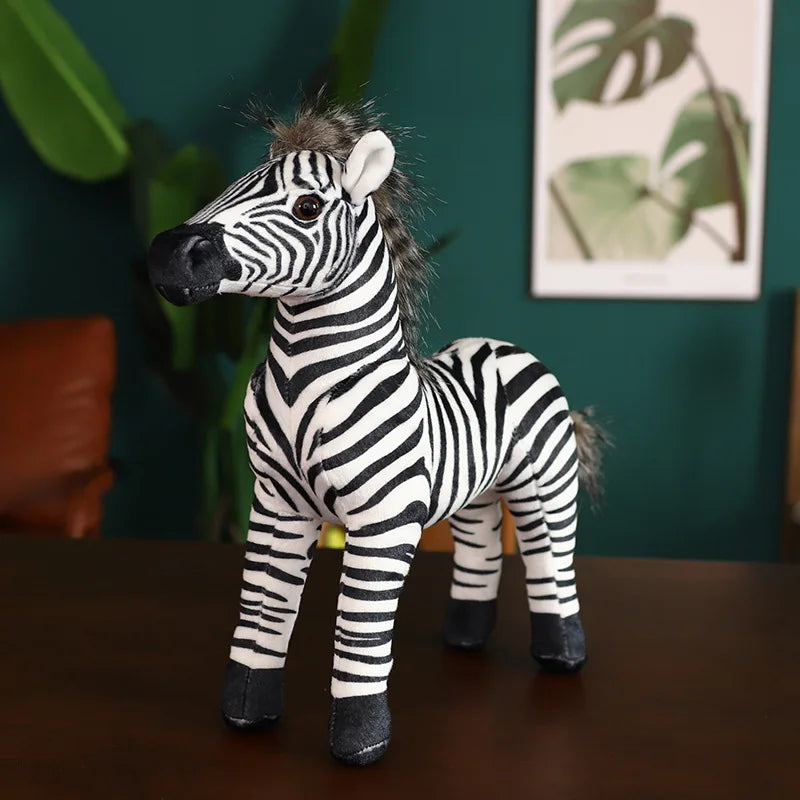
Realistic Standing Zebra Plush 33cm Lifelike Zebra Stuffed Animal Safari Nursery Decor and Gift
Realistic Standing Zebra Plush 33cm Lifelike Zebra Stuffed Animal Safari Nursery Decor and Gift
En existencias
- Free Shipping
- 30 Days Return(T&C applies)
 Customer Support
No se pudo cargar la disponibilidad de retiro
Realistic Standing Zebra Plush 33cm Lifelike Zebra Stuffed Animal for Safari Nursery Decor
Bring the untamed spirit of the African savanna into your home with our premium zebra plush, a freestanding museum quality lifelike zebra plush designed for those who demand true to life detail. Standing at a generous 33cm, this zebra stuffed animal faithfully captures every defining feature of its wild counterpart: bold black and white stripes, a sculpted upright mane, and alert eyes that instantly animate any shelf, nursery, or display space.
About This Zebra Stuffed Toy
This is no ordinary stuffed animal. Our zebra stuffed toy is engineered to stand independently on its own four hooves without any support stand, making it a truly striking standing zebra toy built for display and decor. Whether you are building a safari themed nursery, searching for a standout birthday or baby shower gift, or need an eye catching prop for flat lay and lifestyle photography, this safari plush toy delivers unmatched realism and visual impact.
Constructed from soft, skin safe cotton fabric with a generous PP cotton fill, this realistic animal plush is firm enough to hold its pose while remaining gently huggable and safe. It makes an exceptional plush zebra gift, one that children, collectors, and wildlife enthusiasts will treasure for years to come.
The Zebra: History, Origins and Cultural Legacy
Zebras belong to the genus Equus and are native to the grasslands, savannas, and highland regions of sub-Saharan Africa. Three primary species exist: the Plains Zebra (Equus quagga), Grevy's Zebra (Equus grevyi), and the Mountain Zebra (Equus zebra), with the Plains Zebra being the most widely recognized worldwide. Each zebra's stripe pattern is entirely unique to that individual, much like a human fingerprint. Scientists have studied these markings for over 150 years, with current research strongly supporting the theory that stripes act as a natural defense against biting flies by disrupting the insects' ability to land.
In popular culture and interior design, the zebra has become a powerful symbol of bold individuality and untamed elegance. The safari aesthetic has experienced a dramatic resurgence across Pinterest, Instagram, and parenting communities worldwide, generating consistent demand for zebra nursery decor that brings nature's artistry directly into the home. Our zebra collectible plush was designed to meet exactly this demand, offering authentic lifelike detailing that elevates any safari themed space far beyond ordinary nursery accessories.
As a handmade animal plush crafted with careful attention to proportion, texture, and anatomical accuracy, this piece appeals equally to wildlife enthusiasts, interior decorators, and serious plush collectors. The enduring popularity of safari nursery decor has permanently elevated animal plushies from simple playthings to meaningful decorative statements, and this lifelike zebra plush stands firmly at the top of that category.
Product Highlights
- Freestanding Design: This standing zebra toy holds its position on any flat surface with no stand required, ready to display straight out of the box.
- Lifelike Detailing: Realistic black and white stripe pattern, sculpted upright mane, and expressive eyes modeled faithfully on the real animal.
- Ideal Size 33cm (approx. 13 inches): Perfect for nursery shelves, windowsills, tabletops, and display cabinets.
- Premium PP Cotton Fill: High quality stuffing ensures a full, firm body that retains its shape over time with regular display or handling.
- Skin Safe Materials: Made from soft, non toxic cotton fabric fully suitable for children's bedrooms and nurseries.
- Versatile Use: Ideal as zebra nursery decor, a photography prop, a collector's display piece, or a memorable gift for any occasion.
- Handmade Quality: Every piece is a handmade animal plush, crafted with a level of care and detail that mass produced toys simply cannot replicate.
- Gift Ready Appeal: An exceptional plush zebra gift for birthdays, baby showers, Christmas, and wildlife themed occasions of all kinds.
- Safari Aesthetic: A standout safari plush toy that anchors jungle and wildlife themed interiors with genuine character and presence.
- Collector's Quality: A true zebra collectible plush for enthusiasts who value anatomical accuracy and artistic craftsmanship in their collection.
Why Choose This Zebra Plush?
When searching for the ideal zebra plush for your home or as a gift, quality and authenticity make all the difference. Unlike generic stuffed animals, this zebra stuffed toy stands out for its freestanding construction, lifelike proportions, and premium cotton materials, qualities that make it equally at home on a nursery shelf, inside a collector's cabinet, or in a photographer's prop kit.
For buyers seeking a realistic animal plush that never compromises on safety or visual accuracy, this 33cm piece is the standout choice. And for anyone looking for a distinctive zebra stuffed animal that genuinely goes beyond the ordinary, this handcrafted plush delivers lasting value that keeps impressing long after the first look.
Size Guide
| Measurement | Value | Notes |
|---|---|---|
| Standing Height | 33cm (approx. 13 in) | Measured from hoof base to top of head and ear tip |
| Body Length | approx. 22cm (approx. 8.7 in) | Approximate, from chest to tail base |
| Weight | Lightweight | Easy to display, carry, or pack as a gift |
| Fill Material | PP Cotton | Firm, shape retaining, soft to the touch |
| Outer Material | Cotton Fabric | Soft touch, skin safe surface texture |
Care Instructions
- 🧼 Surface Clean Only: Spot clean using a lightly damp cloth and a small amount of mild soap. Do not submerge in water.
- 🌦 Air Dry: Allow to air dry completely in a well ventilated area, away from direct sunlight or heat sources.
- 🚫 Do Not Machine Wash: Machine washing may distort the shape and damage the realistic surface detailing.
- 🚫 Do Not Tumble Dry: Heat exposure may shrink or warp the cotton fabric and PP cotton fill.
- 🚫 Do Not Iron: Avoid applying direct heat to the plush surface at any time.
- 📦 Storage: Store in a cool, dry location away from prolonged moisture or direct sunlight to preserve color vibrancy and shape integrity.
- 🐾 Keep Away from Pets: To preserve the product's appearance and detailing, keep away from pets that may chew or scratch the fabric.
FAQ: Zebra Facts, Science and Wild Curiosities
This is one of the most searched zebra questions online and the answer is genuinely fascinating. Zebras are genetically black animals with white stripes. During embryonic development, pigment producing cells called melanocytes are selectively suppressed in the areas that will become white stripes. The underlying skin beneath those white areas is also black, confirming that black is the base color of the animal. This finding was reinforced and widely circulated following a University of Bristol study on zebra stripe genetics, and it has since become a popular science fact shared widely across wildlife communities, social media, and nature documentaries.
The purpose of zebra stripes has been debated by scientists for over 150 years and remains an active topic in wildlife biology. The most strongly supported theory today is that stripes deter biting flies, specifically horseflies and tsetse flies. Research published in PLOS ONE by University of Bristol scientists found that significantly fewer horseflies landed on zebras than on plain coated horses, and that the stripe pattern appeared to disrupt the insects' visual ability to land cleanly. Other active theories include thermoregulation (the boundary between dark and light stripes may generate small cooling air currents), social recognition within the herd, and visual disruption during group stampedes to confuse pursuing predators. As of the most recent research cycles, the anti insect hypothesis holds the strongest experimental support by a considerable margin.
Zebras cannot be reliably domesticated in the way horses have been, and this is a question that surfaces frequently among wildlife enthusiasts and fans of animal documentaries. Despite being closely related to horses and donkeys (all within the genus Equus), zebras evolved under intense predator pressure in Africa, giving them a far more reactive and unpredictable temperament. They have a stronger kick reflex, bite more readily, and panic far more easily than horses. Unlike horses, which were selectively bred by humans over thousands of years for docility and cooperation, zebras were never brought through that domestication process at scale. Several historical attempts were made by European colonists in Africa during the 19th and early 20th centuries, but none proved workable in the long term. This untameable wild nature is a significant part of what makes zebras such enduring and compelling symbols in art, design, and wildlife culture worldwide.
Zebra conservation status varies by species and is a growing concern for wildlife organizations globally. The Plains Zebra, the most recognized and widespread species, is currently listed as Near Threatened on the IUCN Red List, with population declines linked to habitat loss, drought, and hunting pressure. Grevy's Zebra, the largest of the three species, is classified as Endangered, with estimates placing fewer than 3,000 individuals remaining in the wild, making it one of Africa's most at risk large mammals. The Mountain Zebra is listed as Vulnerable. Organizations including WWF, the Grevy's Zebra Trust, and several African national parks run active protection and community based conservation programs. Public interest in zebras through wildlife tourism, education, themed decor, and collectibles plays a small but meaningful role in sustaining awareness around zebra conservation.
The safari nursery aesthetic has grown into one of the most dominant nursery design trends of the past five years, consistently ranking at the top of Pinterest search results and Instagram home decor feeds. The trend is driven largely by a cultural shift away from gender specific nursery palettes toward neutral, nature inspired color schemes: warm beiges, earthy greens, soft terracottas, and the bold graphic contrast of black and white animal prints. The zebra is particularly central to this movement: its naturally monochromatic stripe pattern integrates seamlessly into modern nurseries that favor clean, high contrast visuals and organic textures. Interior design influencers and baby product brands have leaned heavily into this aesthetic, generating sustained demand for wildlife themed art, textile prints, and realistic animal plush pieces as decor anchors. The zebra's timeless, universally beloved design ensures it remains a safari nursery staple regardless of seasonal trends.


Frequently Bought Together
-
Sad Lil' Smoke Ghost Plush Keychain | Funny Cigarette Elf Bag Charm | Handmade Ghost Plush 13cm
Precio habitual $47.25 AUDPrecio habitualPrecio unitario por$0.00 AUDPrecio de oferta $47.25 AUD -
Realistic Standing Zebra Plush 33cm Lifelike Zebra Stuffed Animal Safari Nursery Decor and Gift
Precio habitual $53.95 AUDPrecio habitualPrecio unitario por$0.00 AUDPrecio de oferta $53.95 AUD -
Lifelike Standing Elephant Plush | Realistic Safari Stuffed Animal | Calming Nursery Handmade Plush Toy
Precio habitual A partir de $53.95 AUDPrecio habitualPrecio unitario por$0.00 AUDPrecio de oferta A partir de $53.95 AUD -
Kawaii Christmas Snowman Mini Plush Toy | Cute Snow Man Plush with Pastel Pink Scarf | Holiday Bag Charm Keychain Doll | 12cm Festive Stocking Stuffer
Precio habitual $47.25 AUDPrecio habitualPrecio unitario por


Suggested Blog posts:
Ver todo-

Crunchyroll Fall 2026 Anime Lineup: Is the New ...
Black Clover is back after 5 years. Apothecary Diaries returns. Is Crunchyroll's Fall 2026 lineup its best ever? Every show, date, and our honest verdict.
Crunchyroll Fall 2026 Anime Lineup: Is the New ...
Black Clover is back after 5 years. Apothecary Diaries returns. Is Crunchyroll's Fall 2026 lineup its best ever? Every show, date, and our honest verdict.
-
![[CURVE SHOTS!] Illegal Soccer Roblox Guide: Best Shots, Controls and How to Score Every Time](//www.aprasi.com/cdn/shop/articles/noFilter_21.webp?v=1789624183&width=533)
[CURVE SHOTS!] Illegal Soccer Roblox Guide: Bes...
How to curve shot in Illegal Soccer Roblox — all 4 combos, full controls, every item ranked, goalkeeper system, and tips to score every time.
[CURVE SHOTS!] Illegal Soccer Roblox Guide: Bes...
How to curve shot in Illegal Soccer Roblox — all 4 combos, full controls, every item ranked, goalkeeper system, and tips to score every time.
-

Capcom Crossover: Diana and Mega Man Are Now Of...
Diana and Mega Man are officially a duo. Here's the full story behind Capcom's wild crossover—from a fan theory to DLC skins, new art, and E-Capcom merch.
Capcom Crossover: Diana and Mega Man Are Now Of...
Diana and Mega Man are officially a duo. Here's the full story behind Capcom's wild crossover—from a fan theory to DLC skins, new art, and E-Capcom merch.
-

Witch and Mercenary Anime: 2027 Premiere, Cast,...
Witch and Mercenary anime arrives in Winter 2027 on Nippon TV. Get the full cast, staff, trailer, and source material guide before the premiere.
Witch and Mercenary Anime: 2027 Premiere, Cast,...
Witch and Mercenary anime arrives in Winter 2027 on Nippon TV. Get the full cast, staff, trailer, and source material guide before the premiere.

![[CURVE SHOTS!] Illegal Soccer Roblox Guide: Best Shots, Controls and How to Score Every Time](http://www.aprasi.com/cdn/shop/articles/noFilter_21.webp?v=1789624183&width=533)


Verified Google Reviews
Hear It from Our Customers