


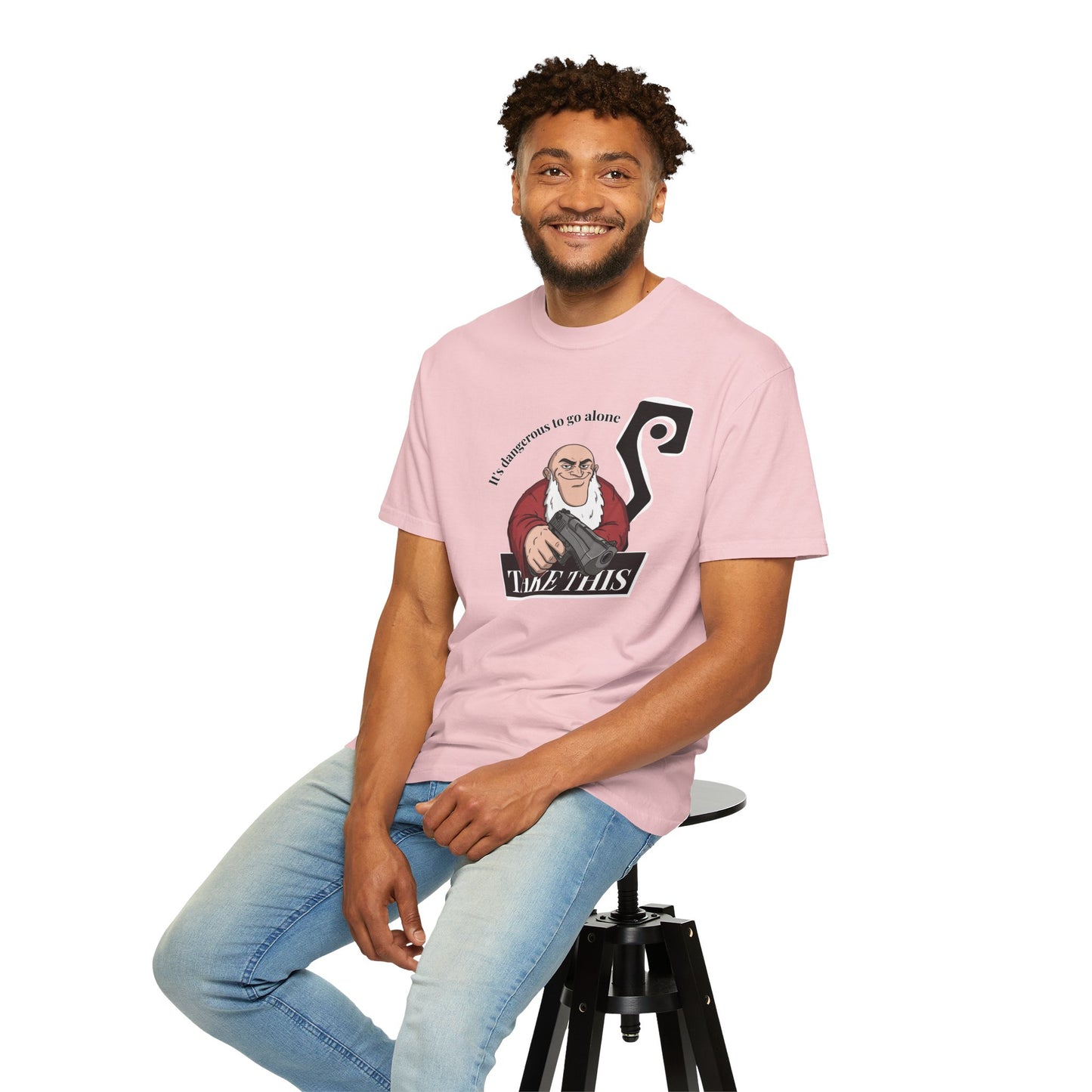
Take This T-Shirt — Vintage Judge Illustration ‘If Sorrow To Sin Alone’ Graphic Tee
Take This T-Shirt — Vintage Judge Illustration ‘If Sorrow To Sin Alone’ Graphic Tee
En existencias
- Free Shipping
- 30 Days Return(T&C applies)
 Customer Support
No se pudo cargar la disponibilidad de retiro
Take This Funny Tee: Vintage Judge Illustration “If Sorrow To Sin Alone” Graphic Tee
Some shirts just land differently. This take this funny tee leads with an aged engraving of a robed judge, rendered in the ink-heavy linework of Victorian-era satirical illustration, paired with the wry phrase If Sorrow To Sin Alone. It is the kind of image that stops a scroll, earns a second look in passing, and sparks a conversation you were not expecting. Whether you wear it to a gallery opening, a late-night diner run, or simply out the door on a Tuesday, this is a dark academia graphic tee that does the talking for you.
Printed on the legendary Comfort Colors 1717 heavyweight garment-dyed blank, every detail of the construction is built to match the weight of the image it carries. The cotton is soft from the first wear, the dye deepens with every wash, and the relaxed tubular fit sits comfortably on every body type across sizes S through 3XL. This is a vintage aesthetic t-shirt built to outlast trends, not chase them.
The Illustration: A History Worth Wearing
The image draws directly from the golden age of American and British satirical illustration, specifically the visual tradition of publications like The Judge, a weekly humor magazine that ran from the 1880s through the early twentieth century. These publications employed some of the finest commercial illustrators of their era to produce wood-engraved and lithographed caricatures of authority figures: politicians, clergymen, lawyers, and judges rendered in exaggerated, almost grotesque detail to puncture the pomposity of the powerful.
The figure of the judge was a recurring character in this tradition. Robed, be-wigged, and seated on a raised bench, the judge represented the full weight of institutional judgment, the authority to declare right from wrong, guilt from innocence, sorrow from sin. The irony that such figures were themselves often corrupt, vain, or simply absurd was not lost on the illustrators of the era, and the gap between their formal gravity and their human fallibility gave the vintage judge illustration its lasting satirical charge.
The phrase If Sorrow To Sin Alone layers a second tradition on top of this visual one: the Victorian poetic preoccupation with guilt, grief, and the thin line between them. Alfred Lord Tennyson famously wrote in In Memoriam that he sometimes held it half a sin to put in words the grief he feels, drawing grief and sin into the same sentence as overlapping states. The phrase on this shirt operates in the same territory, a fragment that functions as both question and verdict, suggesting that if suffering were the measure of wrongdoing, most of us would stand condemned. As a dark humor philosophy tee, it is more than a curiosity: it is a small piece of literary and visual history you can actually wear.
In the current era of dark academia aesthetic clothing, where vintage engravings, gothic typography, and classical literary references have become defining visual signals for readers, artists, and anyone who has ever found a rainy library afternoon genuinely restorative, this graphic sits at the precise intersection of historical authenticity and contemporary wearability. It is not nostalgia for its own sake. It is a reference that earns its place.
Product Highlights
- Garment-dyed heavyweight cotton at 6.1 oz, 100% ring-spun US cotton, pre-shrunk for a lived-in feel from day one
- Comfort Colors 1717 construction, widely regarded as the gold standard for premium heavyweight graphic tees
- Vintage judge illustration graphic centered on the front chest, printed with high-resolution detail to honour the linework of the original engraving style
- Dark academia aesthetic wearable across multiple contexts: studio, campus, creative workspaces, casual social settings
- Tubular knit construction with no side seams for cleaner drape, reduced fabric waste, and a silhouette that sits well untucked or layered
- Double-needle stitching on all seams including armholes, sleeves, and bottom hem for long-lasting durability
- Topstitched classic-width rib collar and shoulder-to-shoulder twill tape for structural integrity over repeated wear
- Sewn-in signature twill label, soft against the neck with no itching
- Available in a wide range of garment-dyed colorways, sizes S to 3XL
- OEKO-TEX certified low-impact dyes; salt-free pigment dye process; plastic packaging removed at production
- Designed by Aprasi
Size Guide
This tee runs with a relaxed, slightly oversized fit. If you prefer a more fitted silhouette, consider sizing down one. All measurements are in inches and represent flat garment dimensions.
| Size | Width (in) | Length (in) | Sleeve from Center Back (in) | Tolerance (in) |
|---|---|---|---|---|
| S | 18.25 | 26.62 | 16.25 | +/- 1.50 |
| M | 20.25 | 28.00 | 17.75 | +/- 1.50 |
| L | 22.00 | 29.37 | 19.00 | +/- 1.50 |
| XL | 24.00 | 30.75 | 20.50 | +/- 1.50 |
| 2XL | 26.00 | 31.62 | 21.75 | +/- 1.50 |
| 3XL | 27.75 | 32.50 | 23.25 | +/- 1.50 |
Tip: Measure a shirt you already love flat across the chest and compare to the width column for the most accurate fit. Garment-dyed cotton has already been pre-shrunk during production, so what you receive is what you keep.
Care Instructions
Keep It Looking Great
- Machine wash cold (max 30C / 90F) to preserve the garment-dyed color and graphic integrity
- Do not bleach
- Tumble dry on low heat
- Iron, steam, or dry on low heat only; avoid direct iron contact with the graphic
- Do not dry clean
Garment-dyed cotton softens and develops a unique patina with each wash. Washing inside-out on cold extends the life of both the dye and the print.
Why This Graphic Works in 2026
The dark academia aesthetic t-shirt market has matured well beyond simple skull graphics and Gothic serif fonts. What buyers are reaching for now is specificity: images with actual historical grounding, phrases that hold up to being read twice, and constructions that justify their price point with real fabric weight and durability. This literary quote graphic tee delivers on all three counts.
The funny philosophy tee category, which sits at the crossroads of ironic humour and genuine intellectual reference, has become one of the most reliably engaged segments on platforms from TikTok to Depop. Images pulled from public-domain Victorian illustration, recombined with literary fragments that reward close reading, hit precisely the cultural register that Gen Z and young Millennials are currently paying premium prices to own. This is not fast fashion. This is a wearable literary art tee with a story behind every thread.
This shirt is also an excellent choice for anyone shopping for a unique gift for book lovers. Whether the recipient is a philosophy student, a self-described literary nerd, an art history enthusiast, or simply someone who appreciates wearable objects that are genuinely surprising, the combination of the vintage engraving, the heavyweight canvas, and the Aprasi graphic sensibility makes this a gift that stands apart from anything available at a chain retailer.
The garment is manufactured in Honduras by the Comfort Colors team in OEKO-TEX and FLA certified facilities. EU customers benefit from a 2-year statutory warranty as per Directive 1999/44/EC. EU representative: HONSON VENTURES LIMITED, Gnaftis House flat 102, Limassol, Mesa Geitonia, 4003, CY (gpsr@honsonventures.com).
FAQ: The Vintage Judge Aesthetic and the Philosophy Behind the Graphic
The phrase operates as a philosophical fragment rather than a direct quotation from a single source. It echoes a tradition of Victorian moral poetry, particularly the work of Alfred Lord Tennyson, who in In Memoriam (1850) drew grief and sin into close proximity by suggesting he sometimes held it half a sin to put in words the grief he feels. The phrase on this tee extends that tension further: if sorrow were the only thing that could define sin, then suffering itself would become a form of guilt. It is a question disguised as a verdict, and intentionally unresolved. The Victorian satirical press, whose illustrated tradition this graphic draws from, loved this kind of layered moral irony. The phrase reads differently depending on whether you come to it as a cynic, a theologian, or someone who has just had a very long week.
The dark academia aesthetic and vintage illustration trend has shifted from a Tumblr-era subcultural signal into a commercially significant mainstream movement in 2025 and 2026. Several forces are converging: exhaustion with algorithmic, AI-generated aesthetics is pushing buyers toward images with genuine historical provenance; the resurgence of reading culture (BookTok, literary subcultures, independent bookshops) is creating demand for wearable objects that signal cultural literacy rather than brand affiliation; and Victorian-era public domain engravings, with their dense linework and inherent ironic potential, have become one of the most remixed visual archives in contemporary graphic design. The judge as an archetypal figure, robed, authoritative, and faintly absurd, carries particular resonance for a generation deeply interested in questions of institutional power, judgment, and moral complexity.
Satirical judge imagery has roots stretching back to William Hogarth in the eighteenth century, whose engravings of courtroom scenes exposed the theatre and corruption behind formal legal authority. By the mid-nineteenth century, publications like Punch in Britain and The Judge in the United States had industrialised the satirical illustration, employing staff artists to produce woodcut-style and lithographic caricatures of public figures weekly. The judge was a recurring subject because the role concentrated so many satirisable qualities: the elaborate costume of wigs and robes, the theatrical staging of the bench and dock, the solemn pretence of objectivity from someone who was, ultimately, just another human being with opinions and biases. Later, artists in the Robert Crumb tradition of underground comics carried this irreverent visual language into the twentieth century, and the internet has since enshrined many of these images as proto-memes, rediscovering their emotional relevance for entirely new cultural contexts.
The dark academia aesthetic is built on a cluster of visual and intellectual references: classical architecture, candlelit libraries, Gothic typography, Victorian botanical illustrations, and a broadly melancholic intellectualism that finds beauty in the weight of history. Legal imagery, and particularly the figure of the robed judge drawn from centuries-old illustration traditions, fits this aesthetic precisely because it carries those qualities of institutional gravity and historical depth. In current fashion culture, buyers wearing dark academia pieces are communicating something specific: that they are interested in ideas, that they engage with history, and that they prefer wearable objects that reward close attention. A shirt featuring a vintage judge illustration with a philosophically loaded phrase is an almost perfect expression of that sensibility. It has also found significant traction among law students, philosophy majors, literature readers, and anyone who follows the aesthetic across platforms like Pinterest, TikTok, and Depop.
The relationship between sorrow and sin has deep roots in Christian theology, existentialist philosophy, and classical literature. In Christian moral theology, contrition, or genuine sorrow for wrongdoing, has historically been treated as the necessary first step toward absolution, which means sorrow and sin are inseparably linked. Thinkers from Augustine to Kierkegaard explored the idea that guilt is a form of suffering and that suffering can produce a kind of moral knowledge unavailable through any other route. In literature, this tension surfaces everywhere from Dostoyevsky's exploration of guilt in Crime and Punishment to the entire Victorian elegiac tradition. The phrase on this shirt does not resolve this question: it leaves it suspended, letting the wearer and the viewer bring their own reading to it. That openness is deliberate, and it is why the phrase works as a wearable statement rather than a sermon.
Items are not eligible for returns or refunds. Exchanges are offered only in the event of a manufacturing defect or transit damage. Please contact us with photo evidence within 7 days of delivery.


Frequently Bought Together
-
Esquie Missing Pet Rock T-Shirt | Clair Obscur Expedition 33 Game Merch | Whee Whoo Whee Whoo
Precio habitual A partir de $54.19 AUDPrecio habitualPrecio unitario por -
Wait! Aegon Egg Targaryen Meme T-Shirt - A Knight of the Seven Kingdoms Dunk and Egg Graphic Tee
Precio habitual A partir de $52.95 AUDPrecio habitualPrecio unitario por -
Long Live the Freaks Gothic Skeleton Shirt | Dark Aesthetic Graphic Tee for Rebels and Outcasts
Precio habitual A partir de $54.19 AUDPrecio habitualPrecio unitario por -
Concrete Jungle Resident Tee | Bad Omens Urban Graphic Tee | Sector 3
Precio habitual A partir de $54.19 AUDPrecio habitualPrecio unitario por


Suggested Blog posts:
Ver todo-

Top Upcoming Roblox Games You Need to Play Thi...
Roblox's fall 2026 lineup has landed. See every upcoming Roblox game arriving in September and October, including the anime shooter Showdown and racer Octane.
Top Upcoming Roblox Games You Need to Play Thi...
Roblox's fall 2026 lineup has landed. See every upcoming Roblox game arriving in September and October, including the anime shooter Showdown and racer Octane.
-

Uncle's Obsession with Cute Things: Official Re...
Uncle's Obsession with Cute Things premieres October 4, 2026 on Crunchyroll worldwide. Get the full cast, story, and streaming schedule here.
Uncle's Obsession with Cute Things: Official Re...
Uncle's Obsession with Cute Things premieres October 4, 2026 on Crunchyroll worldwide. Get the full cast, story, and streaming schedule here.
-

Is Steel Ball Run Coming to Netflix? Breaking D...
Is Steel Ball Run really coming to Netflix? Get the real 2026 release schedule, episode count, cast, and why fans thought the anime got cancelled.
Is Steel Ball Run Coming to Netflix? Breaking D...
Is Steel Ball Run really coming to Netflix? Get the real 2026 release schedule, episode count, cast, and why fans thought the anime got cancelled.
-

Yomawari: The Long Night Collection and Lost in...
Sora Tanka As a lifelong otaku and pop culture enthusiast, I spend my time exploring underground animation, vintage cinema, and the hidden gems of streaming media. Published: September 7, 2026...
Yomawari: The Long Night Collection and Lost in...
Sora Tanka As a lifelong otaku and pop culture enthusiast, I spend my time exploring underground animation, vintage cinema, and the hidden gems of streaming media. Published: September 7, 2026...


Verified Google Reviews
Hear It from Our Customers