


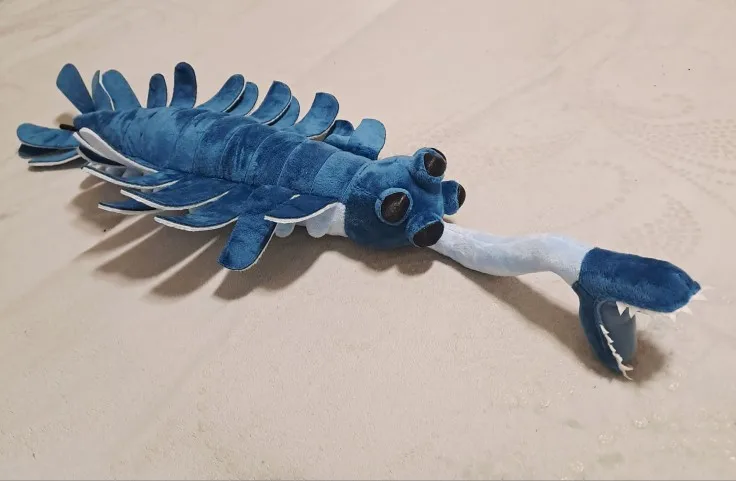
Giant Opabinia Regalis Plush Prehistoric 5-Eyed Cambrian Sea Creature Handmade Plush 17cm
Giant Opabinia Regalis Plush Prehistoric 5-Eyed Cambrian Sea Creature Handmade Plush 17cm
Auf Lager
- Kostenloser Versand
- 30 Tage Rückgaberecht (AGB gelten)
- Kundenbetreuung
Verfügbarkeit für Abholungen konnte nicht geladen werden
Opabinia Regalis Plush — Prehistoric 5-Eyed Cambrian Sea Creature, Handmade Stuffed Toy, 17cm
Meet the most wonderfully weird creature to ever swim the ancient seas. This handmade Opabinia regalis plush brings to life one of paleontology's most famous and baffling animals, a 505-million-year-old Cambrian sea creature with five eyes and a flexible, hose-like snout tipped with a claw. Crafted from soft plush material and filled with premium PP Cotton, this prehistoric plush toy is as huggable as it is scientifically fascinating.
Whether you are a paleontology enthusiast, a natural history collector, a biology student, or simply someone who appreciates the gloriously strange side of life on Earth, this Opabinia stuffed animal is a one-of-a-kind addition to any collection. Standing at 17cm tall, it is compact enough for a desk or shelf but detailed enough to spark a conversation every single time.
What Is Opabinia Regalis?
Opabinia regalis is a species of extinct marine animal discovered in the Burgess Shale fossil beds of British Columbia, Canada. These fossils date to approximately 505 million years ago during the Cambrian Period, one of the most extraordinary eras in the history of life on Earth. The Burgess Shale is a UNESCO World Heritage Site and one of the most important fossil deposits ever found, preserving soft-bodied creatures that left almost no record elsewhere.
When paleontologist Harry Whittington formally described Opabinia regalis in 1975, the scientific community was stunned. The animal had five compound eyes, a segmented body, gills along its sides, and most remarkably, a long flexible frontal appendage resembling a vacuum hose, ending in a claw that is thought to have passed food back to its mouth. When Whittington presented his findings at a scientific conference, the audience reportedly laughed out loud because the creature looked so impossibly bizarre. It has since become one of the most iconic and beloved animals in the entire history of paleontology.
Taxonomically, Opabinia does not fit neatly into any living animal phylum, making it a true evolutionary puzzle. Many researchers now classify it as a close relative of the ancestor of arthropods, the group that today includes insects, spiders, and crustaceans. This makes the five-eyed sea creature not just a curiosity but a critical clue to understanding how complex animal life first evolved.
In recent years, Opabinia regalis has surged in popularity across science communication communities, paleontology social media, and plush collector circles. Its absurd yet endearing anatomy makes it a natural fit for the growing world of science plush toys and paleontology gifts. It has appeared in museum gift shops, viral science posts, and educational merchandise around the world. This handmade version lets you own a piece of that fascination.
Product Highlights
- Depicts Opabinia regalis, the legendary five-eyed sea creature from the Cambrian Period
- Handmade with soft, high-quality plush material
- Filled with premium PP Cotton for a satisfying, huggable feel
- Measures 17cm in height, ideal for desk display or shelf collections
- Features the iconic five-eye arrangement and elongated frontal appendage of the real animal
- Perfect as a paleontology gift, science novelty, or Cambrian creature plush collectible
- Great for biology students, museum lovers, natural history collectors, and curious minds of all ages
- A standout among prehistoric animal plush toys and science plush toys
- No franchise or IP, just pure prehistoric science made soft and snuggly
Size Guide
| Dimension | Measurement |
|---|---|
| Height | 17cm (approximately 6.7 inches) |
| Material | Plush exterior, PP Cotton filling |
| Style | Stuffed and plush |
Care Instructions
Keeping Your Opabinia Plush in Great Condition
- Surface clean only with a soft, damp cloth
- Do not machine wash or tumble dry
- Keep away from direct sunlight for extended periods to preserve color
- Not recommended for children under 3 years of age
- Store in a cool, dry place when not on display
- Gently reshape by hand after handling to maintain the original form
The Perfect Paleontology Gift and Science Collectible
Looking for a truly unique present? This Opabinia regalis plush is the ideal gift for anyone fascinated by prehistoric life, evolutionary biology, or natural history. It doubles as a conversation piece, a desk companion, and a genuine collector's item. Among prehistoric animal plush toys, few carry the scientific backstory and visual personality of Opabinia. It is part of a growing genre of science plush toys that celebrate the strange beauty of real biology, and it fits perfectly alongside other Cambrian creature plush designs for those building a prehistoric collection.
From the Burgess Shale to your shelf, this little five-eyed sea creature has had quite a journey. Add it to your world today.
FAQ: Opabinia Regalis and the Cambrian World
Scientists believe the five eyes of Opabinia regalis gave it a wide field of vision across different angles, which would have been a significant advantage in the complex, predator-filled waters of the Cambrian sea. Two of the eyes appear to have faced forward or upward while others provided coverage from different directions. This multi-eyed arrangement is not unique to Opabinia, as many Cambrian animals experimented with unusual sensory configurations, but five eyes in a single creature remain one of the most striking examples. It is a reminder of just how different and experimental early animal life was, long before evolution settled on the body plans we see in creatures today.
Most paleontologists think Opabinia regalis was likely a predator or an opportunistic feeder rather than a pure scavenger. Its long frontal appendage, often described as resembling a vacuum hose, ended in a claw or grasping structure. Researchers believe it used this appendage to probe into soft sediment or capture small prey, then passed the food backward toward its mouth, which faced downward and rearward rather than forward. This feeding style is unusual even by Cambrian standards and has no direct parallel in living animals, making Opabinia one of the most fascinating examples of early predatory adaptation in the fossil record.
Fossils of Opabinia regalis were first collected from the Burgess Shale in British Columbia in the early twentieth century, but the animal was not formally and fully described until 1975, when paleontologist Harry Whittington published a detailed study. When he presented his findings to a scientific audience, the reaction was reportedly laughter, because the reconstruction looked so bizarre and unlike anything alive or previously known. The name Opabinia comes from Opabin Pass, a mountain pass near the Burgess Shale site. The discovery and subsequent study of Opabinia regalis played a major role in reshaping how scientists understand Cambrian animal diversity and the deep roots of the arthropod lineage.
Opabinia regalis does not belong to any surviving animal phylum, but current research places it close to the evolutionary lineage that gave rise to the arthropods, the group that includes today's insects, crustaceans, and spiders. It is considered part of a broader category of Cambrian animals sometimes called radiodont relatives, a group that also includes the more famous Cambrian sea creature Anomalocaris. While Opabinia itself left no direct living descendants, studying it helps scientists piece together the evolutionary steps that eventually produced the most species-rich group of animals on Earth. In that sense, every insect and crustacean alive today carries a distant echo of the Cambrian ocean world that Opabinia once inhabited.
Opabinia regalis has become a beloved figure across paleontology communities, science education platforms, and collector circles for several reasons. Its appearance, with five eyes and a claw-tipped frontal tube, is so outlandish that it immediately captures attention. It features prominently in popular science books, documentaries, and social media posts about the Cambrian Explosion, one of the most discussed events in evolutionary biology. Museum gift shops and independent makers have embraced it as a subject for merchandise, and the rise of science plush toys and prehistoric animal plush toys as a collector category has brought renewed mainstream attention to creatures like Opabinia. It has also gained traction as a symbol of how strange and wonderful real science can be, often shared by educators and enthusiasts as proof that truth is stranger than fiction.


Wird oft zusammen gekauft
-
Adorable Grey Donkey Plush Fluffy Stuffed Animal Handmade Plush 25cm
Normaler Preis $52.95 AUDNormaler PreisStückpreis pro$0.00 AUDVerkaufspreis $52.95 AUD -
Monika Plush, 10cm Handmade Chibi Collectible, Just Monika Fan Gift
Normaler Preis $52.95 AUDNormaler PreisStückpreis pro$0.00 AUDVerkaufspreis $52.95 AUD -
3D Lifelike Cat Plush Pillow, Realistic Photo-Printed Sitting Kitty Plushie 48cm, Choose Your Breed
Normaler Preis $63.95 AUDNormaler PreisStückpreis pro$0.00 AUDVerkaufspreis $63.95 AUD -
Green Monster Plush Holiday String Lights Bag Charm and Nightmare Christmas Decoration Handmade Plush
Normaler Preis $47.25 AUDNormaler PreisStückpreis pro$0.00 AUDVerkaufspreis $47.25 AUD


Vorgeschlagene Blogbeiträge:
Alle anzeigen-

How to Get the Alien Mutation in Steal an Egg (...
Learn how to get the Alien Mutation in Steal an Egg: find Paranoid Pete, farm UFO Debris, roll for Abducted, and open the secret UFO vault before Update 12.
How to Get the Alien Mutation in Steal an Egg (...
Learn how to get the Alien Mutation in Steal an Egg: find Paranoid Pete, farm UFO Debris, roll for Abducted, and open the secret UFO vault before Update 12.
-

ArcheAge Chronicles Gameplay Walkthrough: Compl...
ArcheAge Chronicles gameplay walkthrough for beginners: hidden quests, your first glider and mount, stats, gear upgrades and PvP. Start your run right here.
ArcheAge Chronicles Gameplay Walkthrough: Compl...
ArcheAge Chronicles gameplay walkthrough for beginners: hidden quests, your first glider and mount, stats, gear upgrades and PvP. Start your run right here.
-

New Sims 4 Update: Free Elder Items, Body Toggl...
The latest Sims 4 update is here: free Elder items, weight and muscle toggles, lockable TVs, 375+ recipes and 150+ fixes. See what changed and what’s broken.
New Sims 4 Update: Free Elder Items, Body Toggl...
The latest Sims 4 update is here: free Elder items, weight and muscle toggles, lockable TVs, 375+ recipes and 150+ fixes. See what changed and what’s broken.
-

D&D World of Warcraft Gameplay Expansion: Walkt...
D&D World of Warcraft gameplay expansion walkthrough and guide: classes, species, renown, dungeons, price and how to run your first Azeroth session.
D&D World of Warcraft Gameplay Expansion: Walkt...
D&D World of Warcraft gameplay expansion walkthrough and guide: classes, species, renown, dungeons, price and how to run your first Azeroth session.


Verifizierte Google-Rezensionen
Das sagen unsere Kunden