


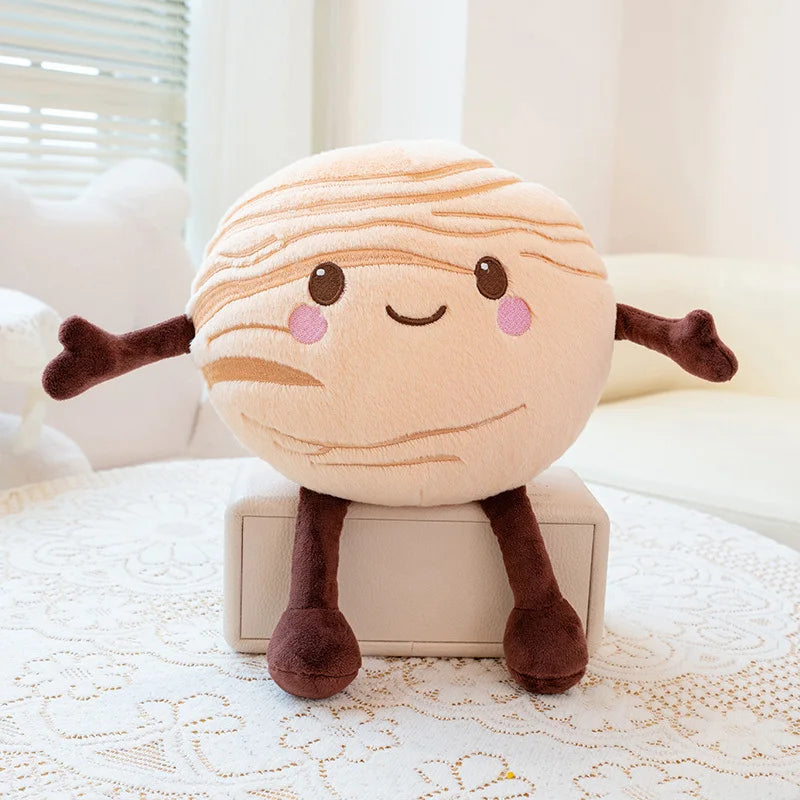
Planet Plushies Earth Plush Mars Plush Saturn Plush Venus Plush Moon Plush Sun Plush Solar System Handmade Plushies 20cm
Planet Plushies Earth Plush Mars Plush Saturn Plush Venus Plush Moon Plush Sun Plush Solar System Handmade Plushies 20cm
现货
- Free Shipping
- 30 Days Return(T&C applies)
 Customer Support
无法加载取货服务可用情况
Planet Plush Toys, 20cm Soft Stuffed Celestial Plushies Including Earth Plush, Mars Plush, Saturn Plush, Venus Plush, Moon Plush and Sun Plush
Bring the wonder of outer space into your hands with our handmade planet plush collection. Each planet plush is crafted with care, measuring 20cm and filled with soft cotton and polyester for an irresistibly huggable feel. Whether you are looking for an earth plush, a mars plush, a venus plush, a moon plush, or any other celestial body from our solar system, this collection brings the cosmos to life in the softest way possible. Perfect for astronomy lovers, space enthusiasts, curious kids, and collectors alike, these stuffed planet toys make an educational gift with a whole lot of charm.
Our solar system is home to eight remarkable planets, each with its own personality, color, and mystery. From the rusty red of Mars plush to the swirling blues of earth plush, and the iconic rings of our Saturn plush, every detail is designed to spark curiosity and delight. The moon plush captures the cratered, silvery glow of Earth's closest neighbor, while the radiant sun plush brings warmth and brightness to any shelf or cuddle session.
Product Highlights
- Planet plush collection featuring Earth, Mars, Saturn, Venus, Moon, and Sun designs
- Handmade with soft, high-quality plush material for a premium feel
- Filled with cotton and polyester for a perfectly squishy, huggable texture
- 20cm size, ideal for display, gifting, or everyday cuddling
- Earth plush features realistic blue and green tones inspired by our home planet
- Mars plush showcases the iconic red surface of the Red Planet
- Venus plush captures the golden, cloud-covered beauty of our nearest planetary neighbor
- Moon plush rendered in soft grey with surface detail evoking the lunar landscape
- Celestial stuffed toys suitable for all ages from young children to adult collectors
- Great for classroom decoration, space-themed bedrooms, astronomy gifts, and science enthusiasts
The Story Behind the Planets: Our Solar System in Plush Form
Planets have fascinated humanity for thousands of years. Ancient civilizations observed bright wandering lights in the night sky and named them after their most powerful gods. The word "planet" itself comes from the ancient Greek for "wandering star." For centuries, only five planets were known to the naked eye: Mercury, Venus, Mars, Jupiter, and Saturn. It was not until the invention of the telescope in the 17th century that Uranus and Neptune were discovered, completing our modern picture of the solar system.
In 2006, the International Astronomical Union redefined what a planet is, officially requiring it to orbit the Sun, have enough mass to achieve a nearly round shape, and have cleared its orbital neighborhood of debris. This definition famously reclassified Pluto as a dwarf planet. Today, our solar system is recognized to have eight official planets divided into two groups: the inner terrestrial planets (Mercury, Venus, Earth, and Mars) and the outer gas and ice giants (Jupiter, Saturn, Uranus, and Neptune).
The rising popularity of space-themed plush toys, especially planet plush designs and solar system stuffed animals, reflects a global surge of interest in space exploration. Missions like NASA's Perseverance rover on Mars, the James Webb Space Telescope's breathtaking imagery, and the Artemis program's return to the Moon have brought the cosmos back into everyday culture. Space aesthetics have taken over merchandise, art, and decor, making a mars plush, earth plush, or moon plush as relevant and sought-after today as ever.
Earth Plush: Our Blue Marble in Soft Form
Earth is the third planet from the Sun and the only known world to support life. Its distinctive blue and green appearance, earned by vast oceans and lush continents, makes the earth plush instantly recognizable. This earth plush celebrates the planet that is home to all of us.
Mars Plush: The Red Planet, Now Huggable
Mars is the fourth planet from the Sun and the most explored planet beyond Earth. Its vivid red color comes from iron oxide on its surface. Our mars plush captures that iconic ruddy hue. With ongoing rover missions and human Mars exploration on the horizon, the mars plush is a timely and inspiring gift for any space fan.
Venus Plush: The Veiled Planet
Venus is the second planet from the Sun and the hottest planet in the solar system despite not being the closest to it. Wrapped in thick clouds of sulfuric acid, its surface is hidden from direct view. Our venus plush renders this mysterious world in soft golden tones, making the venus plush a unique and fascinating addition to any collection.
Moon Plush: Earth's Constant Companion
The Moon is Earth's only natural satellite and the fifth largest moon in the solar system. It has guided human culture, agriculture, and timekeeping for millennia. Our moon plush evokes its cratered, silver-grey surface. The moon plush is a beloved choice for fans of lunar science and space history alike.
Saturn Plush: The Ringed Wonder
Saturn is the sixth planet from the Sun and arguably the most visually striking, famous for its stunning ring system. Our Saturn plush lovingly recreates those iconic rings in soft material. A solar system plush collection is simply incomplete without a Saturn plush on display.
Sun Plush: The Star at the Heart of Our Solar System
The Sun is a G-type main-sequence star and the gravitational anchor of our entire solar system. Our sun plush glows in warm, vibrant tones, making it the perfect centerpiece for a solar system stuffed animal lineup or a cheerful standalone gift.
Size Guide
| Plush | Height |
|---|---|
| Planet Plush (all variants) | 20cm |
Care Instructions
- Hand wash gently in cold water with mild detergent
- Do not machine wash or tumble dry
- Reshape while damp and allow to air dry fully before use
- Do not bleach or iron
- Keep away from prolonged direct sunlight to preserve colors
- Surface spot cleaning is recommended for minor stains
- Not suitable for children under 3 years due to small parts
FAQ: Planet Facts, Space Exploration, and Celestial Curiosities
Mars is one of the most actively studied planets when it comes to the search for life. Scientists have found strong evidence of ancient liquid water on Mars, including dried riverbeds, lake basins, and mineral deposits that only form in the presence of water. More recently, radar data from the Mars Express orbiter suggested subsurface liquid water may still exist beneath the south polar ice cap. While the current Martian surface is cold, dry, and bombarded by radiation, there is growing scientific interest in whether microbial life could have existed in Mars's warmer, wetter past or might still survive deep underground today. Missions like NASA's Perseverance rover are actively searching for biosignatures in ancient lake sediments.
The James Webb Space Telescope (JWST), launched in December 2021, has offered some of the most detailed observations of solar system planets ever recorded. JWST captured stunning images of Neptune's rings, bringing out detail not seen since the Voyager 2 flyby in 1989. It also revealed new atmospheric data about Saturn's moon Titan and provided fresh insights into the composition of Jupiter's atmosphere and its auroras. Beyond our solar system, JWST has been instrumental in detecting atmospheric molecules on exoplanets, opening a new era of planetary science and deepening our understanding of what makes a planet potentially habitable.
Venus holds the record for the hottest planetary surface in the solar system, reaching average temperatures of around 465 degrees Celsius, hotter than Mercury despite being nearly twice as far from the Sun. The reason is Venus's runaway greenhouse effect. Its thick atmosphere is composed of roughly 96 percent carbon dioxide, which traps heat with extreme efficiency. Clouds of sulfuric acid further reflect incoming solar energy while preventing heat from escaping. This has made Venus a cautionary tale for climate scientists studying greenhouse gas dynamics and a subject of renewed exploration interest, with missions like NASA's DAVINCI and VERITAS targeting Venus in the coming years.
NASA's Artemis program is the space agency's initiative to return humans to the Moon for the first time since Apollo 17 in 1972. The program aims to land the first woman and first person of color on the lunar surface, and to establish a sustainable human presence near and on the Moon as a stepping stone for future crewed missions to Mars. The uncrewed Artemis I mission successfully flew around the Moon in late 2022. Subsequent crewed missions are intended to orbit the Moon and eventually land near the lunar south pole, a region of great scientific interest due to evidence of water ice in permanently shadowed craters. The Moon remains one of the most discussed and exciting destinations in current space exploration.
Exoplanets, or planets orbiting stars other than our own Sun, are discovered primarily through two methods: the transit method and the radial velocity method. The transit method detects the slight dimming of a star's light as a planet passes in front of it, while the radial velocity method tracks the tiny wobble a planet's gravity induces in its host star. NASA's Kepler Space Telescope alone confirmed over 2,600 exoplanets before its mission ended in 2018, and the TESS mission has since confirmed hundreds more. As of 2024, over 5,500 confirmed exoplanets have been catalogued, with thousands of additional candidates awaiting confirmation. The diversity of planetary systems discovered has fundamentally changed our understanding of how planets form and how common Earth-like worlds might be.


Frequently Bought Together
-
Yuji I, Maki Z, Naoya Z Plushies JK Anime Plush Mascot Plushies 20cm
常规价格 $46.99 AUD常规价格单价 单价$0.00 AUD促销价 $46.99 AUD -
Taiga Plush Tiger and Dragon Classic High School Rom-Coms Series Handmade Plush 10cm
常规价格 $42.95 AUD常规价格单价 单价$0.00 AUD促销价 $42.95 AUD -
Asaba Harumasa Plush ZZZ Electric Action Game Character Handmade Plush 10cm
常规价格 $42.95 AUD常规价格单价 单价$0.00 AUD促销价 $42.95 AUD -
Alice Plush Journalist Plush IDV Survivor and Hunter Game Handmade Plush 10cm
常规价格 $42.95 AUD常规价格单价 单价$0.00 AUD促销价 $42.95 AUD


Suggested Blog posts:
查看全部-

The Blacklist Anime: Where to Watch the Full Se...
Looking for The Blacklist anime where to watch? We uncover the truth behind the animated rumors, where to stream the full series, and top 8 anime alternatives.
The Blacklist Anime: Where to Watch the Full Se...
Looking for The Blacklist anime where to watch? We uncover the truth behind the animated rumors, where to stream the full series, and top 8 anime alternatives.
-

Wuthering Waves anime release date: When can we...
Wuthering Waves anime is officially confirmed as Wuthering Waves: Elysium by Kuro Onroad. Here's everything we know about the release date, studio, and story.
Wuthering Waves anime release date: When can we...
Wuthering Waves anime is officially confirmed as Wuthering Waves: Elysium by Kuro Onroad. Here's everything we know about the release date, studio, and story.
-

Flower Dust Anime (Han no Akuta): Where can I w...
The Flower Dust animated PV took the internet by storm in 2026. Here's what Hana no Akuta Re;bloom really is, the story behind it, and whether a full anime is...
Flower Dust Anime (Han no Akuta): Where can I w...
The Flower Dust animated PV took the internet by storm in 2026. Here's what Hana no Akuta Re;bloom really is, the story behind it, and whether a full anime is...
-

Dear Passengers Game : The Ultimate Guide to Su...
Dear Passengers is 2026's most viral co-op game. Learn what it is, how the chaotic airline gameplay works, where to wishlist it on Steam, and survival tips.
Dear Passengers Game : The Ultimate Guide to Su...
Dear Passengers is 2026's most viral co-op game. Learn what it is, how the chaotic airline gameplay works, where to wishlist it on Steam, and survival tips.


Verified Google Reviews
Hear It from Our Customers