


Blue Rose Where Silence Buzzes Floral Graphic Tee, Bee and Butterfly Nature Print Unisex T-Shirt
Blue Rose Where Silence Buzzes Floral Graphic Tee, Bee and Butterfly Nature Print Unisex T-Shirt
现货
- Free Shipping
- 30 Days Return(T&C applies)
 Customer Support
无法加载取货服务可用情况
Designed by Aprasi, aprasi.com
Blue Rose Where Silence Buzzes Graphic Tee, Floral Design Printed Unisex Tee
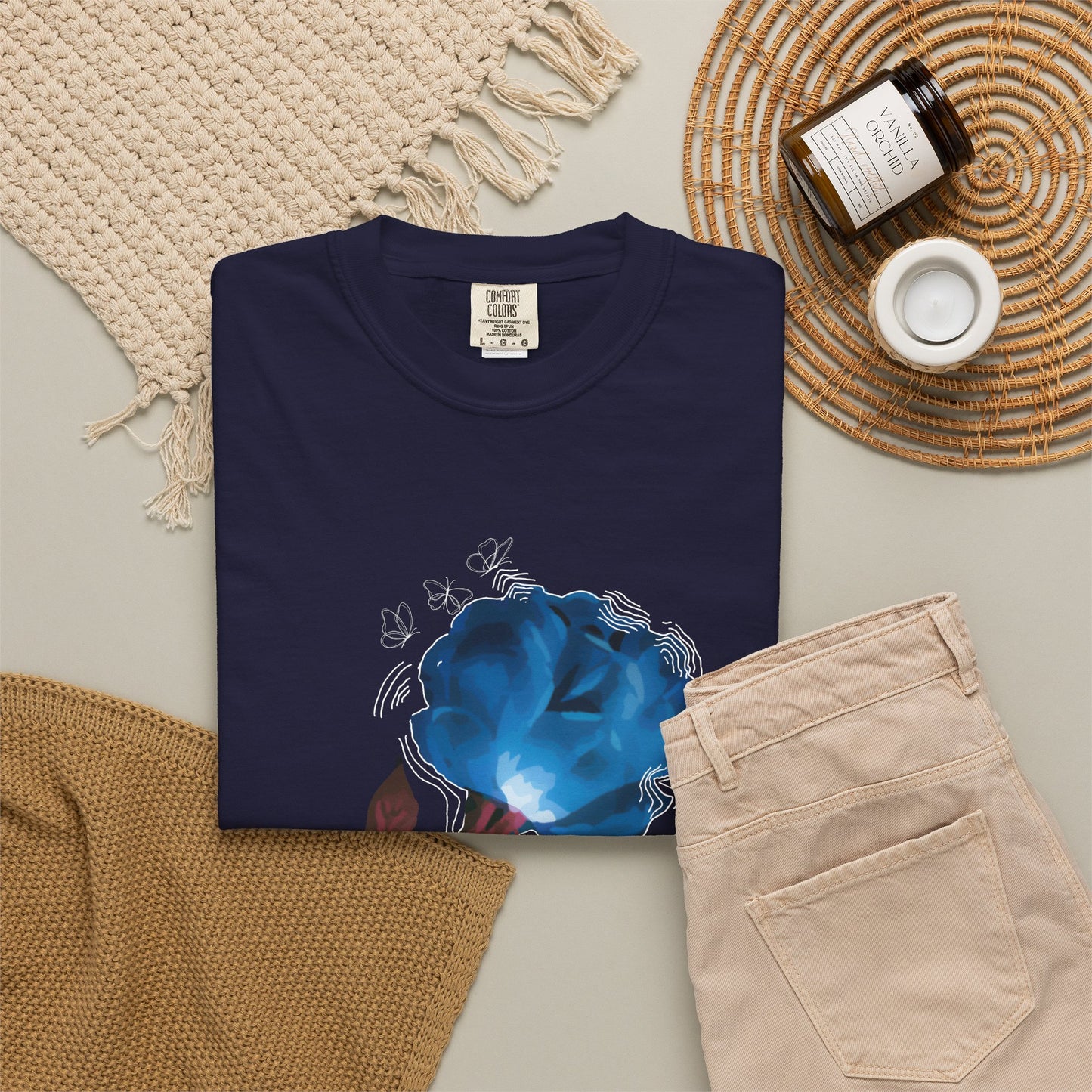
There is a kind of magic that lives in a blooming garden, where bees drift lazily between petals, butterflies catch the light, and the whole world seems to hold its breath. This floral tee was made to carry that feeling wherever you go. The “Where Silence Buzzes” design pairs a striking cobalt blue rose with hovering pollinators in a composition that feels at once peaceful and alive, making it one of the most expressive floral design printed unisex tees you will find. Whether you are a gardener, a beekeeper, a wildflower dreamer, or simply someone who finds calm among blossoms, this piece was designed with you in mind.
The Story Behind the Design: Blue Roses, Pollinators, and the Cottagecore Movement
The blue rose has long occupied a singular place in human imagination. Unlike red, pink, or white roses, the blue rose does not exist in nature. Historically, horticulturists and poets alike regarded it as an impossible dream, a symbol of the unattainable, the mysterious, and the rare. In Victorian flower language (floriography), the blue rose represented the pursuit of the impossible and the longing for what lies just beyond reach. It appeared in literature, mythology, and art across cultures as a shorthand for the extraordinary hidden within the ordinary.
In the modern era, blue roses gained new meaning through the lens of the cottagecore aesthetic, a movement that surged in popularity around 2020 and continues to thrive across TikTok, Pinterest, and Instagram. Cottagecore celebrates a romanticized vision of rural and garden life: slow mornings, wildflower bunches, linen clothing, jars of honey, and the gentle hum of bees. The pollinator, particularly the honeybee and the monarch butterfly, became central symbols of this aesthetic: they represent ecological care, interdependence, and the beauty of systems that sustain life quietly and without fanfare.
The phrase “Where Silence Buzzes” draws directly from this tradition. It captures the paradox of a garden at work, the silence that is not actually silent, but alive with movement and purpose. This idea resonated strongly on social media, where creators began pairing garden imagery with contemplative phrases as part of a wider “slow living” content wave. This design is the ideal cottagecore t-shirt for anyone drawn to that world. As a nature inspired t-shirt rooted in this aesthetic, this design taps into a cultural moment that celebrates presence, ecology, and quiet beauty. It is the kind of wearable art that starts conversations at farmers markets, botanical gardens, and anywhere people who care about the natural world gather.
Product Highlights
- Original “Where Silence Buzzes” blue rose design, a truly distinctive botanical graphic tee celebrating pollinators and garden life
- Printed on the Comfort Colors 1717, a premium garment dyed floral tee blank known for its rich color, soft hand feel, and relaxed vintage drape
- 100% ring-spun US cotton, pre-shrunk and heavyweight at 6.1 oz for durable, lasting wear
- Garment-dyed finish gives every shirt a unique, lived-in tone. No two pieces are exactly alike
- Tubular knit construction (no side seams) with double-needle stitching at cuffs, collar, and hem for lasting structure
- Relaxed unisex fit, ideal as a floral unisex tee that flatters a wide range of body types
- Available in sizes S to 3XL with a sewn-in label for tag-free comfort
- Perfect gift for gardeners, beekeepers, butterfly watchers, plant parents, and slow-living enthusiasts
- Handmade with care, each piece is produced with attention to print quality and garment finishing
A Garden Wearable: More Than Just a Floral Tee
The Comfort Colors 1717 is widely regarded as one of the finest blanks in the premium tee market, and for good reason. Its garment-dye process means the color is absorbed directly into the fabric rather than applied as a surface coating, resulting in a tone that is rich, dimensional, and gets better with every wash. As a garden print tee that will live in your regular rotation, that quality matters: the print stays vivid, the fabric stays soft, and the relaxed fit means it works equally well tucked into high-waisted trousers, layered under a linen shirt, or worn alone on a warm afternoon among the flower beds.
The bee and butterfly graphic tee aesthetic has grown steadily in popularity as consumers seek fashion that connects them to nature and reflects personal values around ecology and sustainability. Pollinators, particularly bees, have become powerful cultural symbols: shorthand for ecological care and the quiet heroism of small things that sustain the world. Wearing a pollinator art shirt is a subtle but meaningful way to carry that message.
The blue rose at the center of this design is rendered in rich cobalt tones that pop beautifully against the garment-dyed base, creating a contrast that feels lush and artistic rather than commercially loud. It is the kind of design that reads as a considered choice, the visual equivalent of picking wildflowers over a bouquet from a supermarket shelf. As a blue flower tee, it occupies a rare space: bold enough to anchor an outfit, subtle enough to wear every day.
This wildflower print shirt is for people who believe the most meaningful moments happen between notifications, in the space where bees hover and time slows down. It is a wearable reminder that beauty does not announce itself. It simply is, if you are paying attention.
Care Instructions
- Machine wash cold (max 30C / 90F) to preserve color and print integrity
- Do not bleach
- Tumble dry on low heat
- Iron, steam, or dry on low heat only
- Do not dry clean
For best results, wash inside out and avoid direct high heat. The garment-dyed finish will continue to soften and develop character with regular washing.
Size Guide
All measurements are in inches. Size tolerance is +/- 1.50 in across all sizes.
| Measurement | S | M | L | XL | 2XL |
|---|---|---|---|---|---|
| Width (in) | 18.25 | 20.25 | 22.00 | 24.00 | 26.00 |
| Length (in) | 26.62 | 28.00 | 29.37 | 30.75 | 31.62 |
| Sleeve (center back, in) | 16.25 | 17.75 | 19.00 | 20.50 | 21.75 |
This is a relaxed-fit tee. If you prefer a closer fit, consider sizing down. The unisex cut is designed to work across body types.
Product Information
Printed on Comfort Colors 1717, 100% ring-spun US cotton, 6.1 oz, garment-dyed. Made in Honduras. Comes with a 2-year warranty in the EU and Northern Ireland as per Directive 1999/44/EC.
EU Representative: HONSON VENTURES LIMITED, gpsr@honsonventures.com, 3 Gnaftis House Flat 102, Limassol, Mesa Geitonia, 4003, CY
FAQ: Blue Roses, Bees, Butterflies & Garden Aesthetics
True blue roses do not exist naturally. Roses lack the pigment delphinidin, which is responsible for blue coloration in flowers like delphiniums and hydrangeas. For centuries, horticulturists attempted to breed a blue rose through hybridization without success, cementing the blue rose as a cultural symbol of the impossible or the rare. In 2004, the Australian biotech company Suntory announced a genetically modified rose with a blue-violet hue using a gene from pansies, though it still reads as lavender rather than a deep cobalt blue. Truly blue roses seen in photographs are almost always the result of natural white roses being dyed or digitally enhanced. This impossibility is part of what gives the blue rose such enduring symbolic power in art, poetry, and wearable design.
Pollinators like bees and butterflies became central symbols of the cottagecore and slow-living movements because they embody the values those aesthetics celebrate: interconnectedness, ecological care, presence, and the beauty of quiet, purposeful work. Bees in particular carry strong cultural weight: they represent community, diligence, and the fragility of natural systems. As awareness of pollinator decline grew through the 2010s and 2020s (Colony Collapse Disorder became widely covered in mainstream media), bees shifted from simple garden visitors to symbols of environmental stewardship. Butterflies, meanwhile, have long symbolized transformation, grace, and the transience of beauty. Together, they form a visual shorthand for a relationship with nature that is attentive, caring, and rooted in appreciation rather than extraction.
Cottagecore is an aesthetic and lifestyle movement that romanticizes rural, pre-industrial living: think linen aprons, wildflower bouquets, bread baking, herb gardens, and reading by open windows. It emerged on Tumblr around 2017 to 2018 and exploded on TikTok and Instagram during 2020, when widespread lockdowns created intense nostalgia for slow, tactile, nature-connected living. Rather than fading, cottagecore has evolved and expanded into adjacent aesthetics like fairycore, dark academia, and goblincore, each building on the same core desire: a life that is slower, more intentional, and more connected to the natural world. Its continued strength reflects a broad cultural shift away from hyper-productivity and digital saturation toward presence, craft, and beauty found in small, everyday things.
The meaning of the blue rose shifts across cultures, but it consistently carries connotations of mystery, the unattainable, and the extraordinary. In Victorian floriography (the language of flowers), the blue rose stood for an impossible love or an unachievable goal, something deeply desired but forever out of reach. In Japanese culture, blue roses have been associated with achieving the unachievable, and the phrase “the miracle of the blue rose” is used to express that something previously thought impossible has come true. In Western literary tradition, the blue rose appears as a symbol of the imagination itself, the capacity to envision what does not yet exist. In contemporary art and fashion, the blue rose often signals rarity, individuality, and a willingness to stand apart from convention.
Botanical and floral fashion has surged in the 2020s as part of a broader cultural turn toward nature, wellness, and what fashion critics call “dopamine dressing, meaning clothing chosen for emotional resonance rather than trend compliance. Garden imagery in particular connects to the slow-living and wellness movements: flowers, bees, and botanicals signal a set of values (care, patience, attention to beauty) that feel meaningful and counter-cultural in an era of rapid digital change. On platforms like TikTok and Pinterest, “garden girl aesthetic” and “floral print fashion” content consistently performs strongly, particularly in spring and summer but with year-round appeal among dedicated communities. Wearing a botanical or floral graphic tee has become a form of soft identity expression, a way of signaling what kind of world you want to live in.
Please note: we do not accept returns or refunds. In the rare case that your item arrives defective or damaged, we will arrange an exchange. Please contact us with a photo of the issue.


Frequently Bought Together
-
Esquie Missing Pet Rock T-Shirt | Clair Obscur Expedition 33 Game Merch | Whee Whoo Whee Whoo
常规价格 来自 $54.19 AUD常规价格单价 单价 -
Wait! Aegon Egg Targaryen Meme T-Shirt - A Knight of the Seven Kingdoms Dunk and Egg Graphic Tee
常规价格 来自 $52.95 AUD常规价格单价 单价 -
Blue Rose Where Silence Buzzes Floral Graphic Tee, Bee and Butterfly Nature Print Unisex T-Shirt
常规价格 来自 $54.19 AUD常规价格单价 单价 -
Witchcore Botanical Skull T-Shirt, Metamorphosis Floral Tee
常规价格 来自 $54.19 AUD常规价格单价 单价


Suggested Blog posts:
查看全部-

Black Grade Anime - Where to Watch This Trimz D...
Black Grade Anime - Where to Watch This Trimz Dark Fantasy Series
Black Grade Anime - Where to Watch This Trimz D...
Black Grade Anime - Where to Watch This Trimz Dark Fantasy Series
-

Fated Killer of the Demon King Anime - Where to...
Fated Killer of the Demon King is free on Trimz by spadesoflove. A horned Demon King raises his fated child killer. Bedtime stories, baby bottles, and archery.
Fated Killer of the Demon King Anime - Where to...
Fated Killer of the Demon King is free on Trimz by spadesoflove. A horned Demon King raises his fated child killer. Bedtime stories, baby bottles, and archery.
-

How a Loner Otaku Bagged The Most Popular Girl ...
How a Loner Otaku Bagged The Most Popular Girl at School is free on Trimz by bluedavincidaniel. School romance with real emotional depth. Not on Crunchyroll.
How a Loner Otaku Bagged The Most Popular Girl ...
How a Loner Otaku Bagged The Most Popular Girl at School is free on Trimz by bluedavincidaniel. School romance with real emotional depth. Not on Crunchyroll.
-

I Accidentally Took the Wrong Pill, Now Every M...
I Accidentally Took the Wrong Pill, Now Every Man Fears Me is free on Trimz by faqehfarwo. School comedy anime — no Crunchyroll, no Netflix, watch free now.
I Accidentally Took the Wrong Pill, Now Every M...
I Accidentally Took the Wrong Pill, Now Every Man Fears Me is free on Trimz by faqehfarwo. School comedy anime — no Crunchyroll, no Netflix, watch free now.


Verified Google Reviews
Hear It from Our Customers